How Partnership Brought a Lifeline Back to Communities After the Earthquake
GLAN, Sarangani ─ As she has done for the past 32 years of working in public service, Glenda Hizoler, General Manager of the Glan Water District, was on her way to the office on the morning the magnitude 7.8 earthquake struck the Municipality of Glan.
Having dedicated the past decades to the Glan Water District, including the last eight years as General Manager, she understood that every decision made in the coming hours would directly affect thousands of families who depended on the municipality’s water system.
Before the earthquake, the Glan Water District supplied safe and reliable water to more than 2,000 concessionaires across seven barangays—Poblacion, Ilaya, Calabanit, Taluya, Tapon, Small Margus, and Big Margus. The Level III Water Supply System, a piped network that delivers water directly to individual household and establishment connections, served as a lifeline for households, schools, businesses, and health facilities, providing communities with the essential water they relied upon every day.
“When the earthquake happened, my first thoughts were not about myself,” Glenda recalled.
“I was worried about our pumping stations, filtration facilities, pipelines, employees, and the office. I knew that if the water system were badly damaged, thousands of families would be affected.”
Upon arriving at the office, she and her team immediately began assessing the damage. While the administrative building sustained only minor cracks, the condition of the water infrastructure was far more alarming. Major distribution pipelines were damaged, one of the district’s critical distribution transformers had failed, and communication with field personnel became increasingly difficult due to widespread power and signal outages.
The situation worsened in the days that followed as detailed assessments revealed extensive damage across multiple components of the Glan Water District’s Level III Water Supply System, affecting its capacity to produce, treat, and distribute water to the communities it served.
Earthquake-induced landslides disrupted water supply from Big Margus Spring Source and the Sitio Calusan Spring Source in Barangay Tapon, two critical water sources supplying nearby communities.
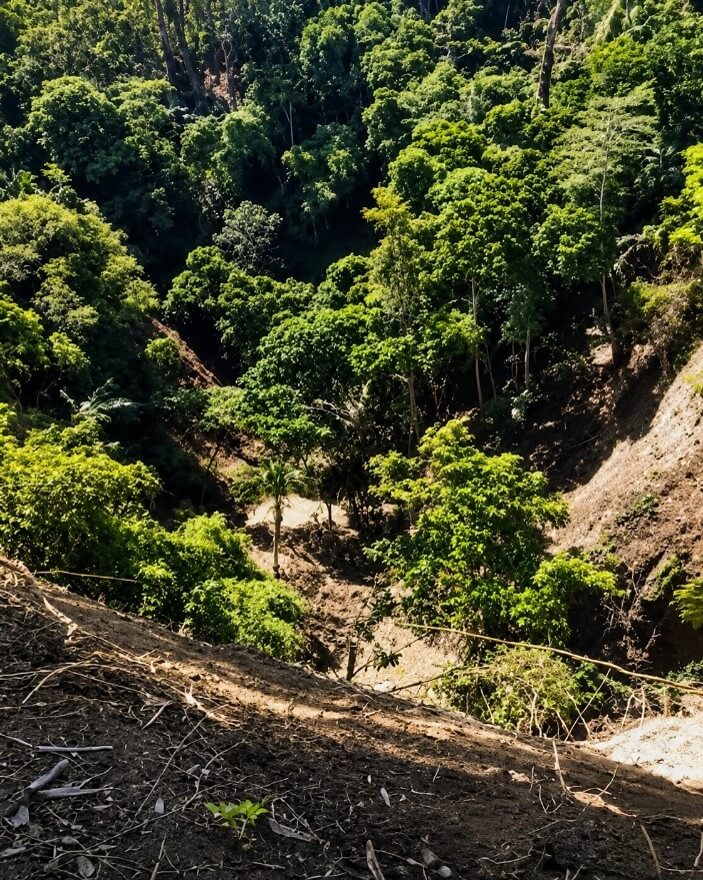
In Photo: Damaged spring source in Barangay Big Margus following Earthquake-induced landslide (Photo by Engel Merl De Villa for Action Against Hunger)
Key water treatment facilities, which play an essential role in treating and maintaining the quality of water before distribution to communities, also sustained significant damage. The Calabanit Filtration Plant sustained damage to its roofing system; the Banahao Filtration Box developed structural damage, and numerous transmission and distribution pipelines were either disconnected or severely compromised.
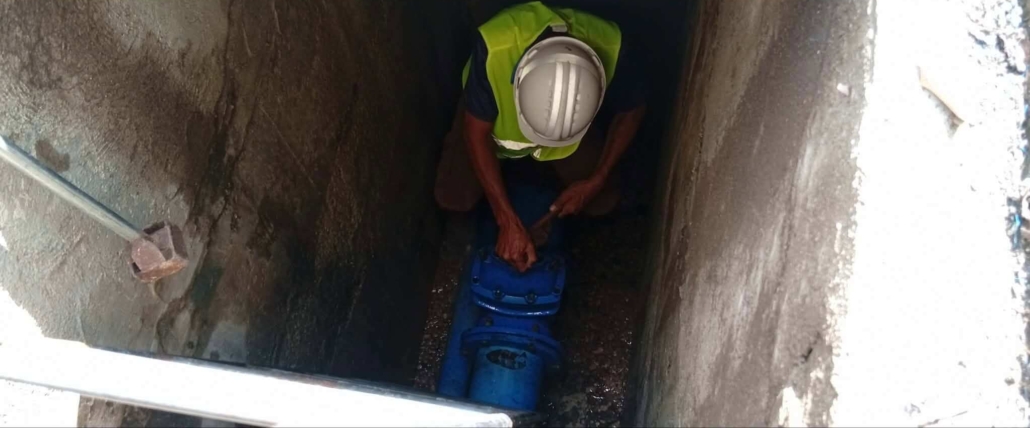
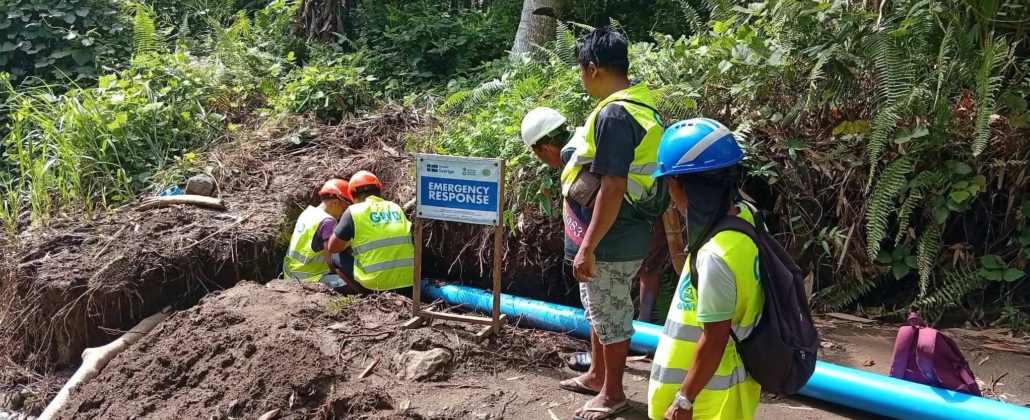
In Photo: In collaboration with Action Against Hunger, Glan Water District personnel repairs damages within the water systems of the Municipality of Glan following the earthquake. (Photo by Engel Merl De Villa for Action Against Hunger)
The damaged transformer had one of the greatest impacts on the entire water supply system. Without electricity, the booster pump at the Calabanit Filtration Plant could not operate sufficiently, making it impossible to generate enough pressure to deliver water to distant communities. The loss of pressure also prevented technical staff from identifying hidden leaks within the distribution network, further delaying restoration efforts.
Despite the overwhelming challenges, Glenda remained focused on what mattered most.
“Our priority was to make sure our employees and their families were safe,” she said. “After that, we began restoring the water system.”
Joint efforts to restore and sustain water supply
As emergency assessments began, neighboring water districts immediately extended assistance. Koronadal Water District, Polomolok Water District, Kabacan Water District, and other organizations, such as the Philippine Red Cross, mobilized water tankers, pipes, fittings, water kits, and technical support to help address the immediate needs of affected communities. Water trucking operations became essential while technical staff worked to assess the extensive damage across the municipality.
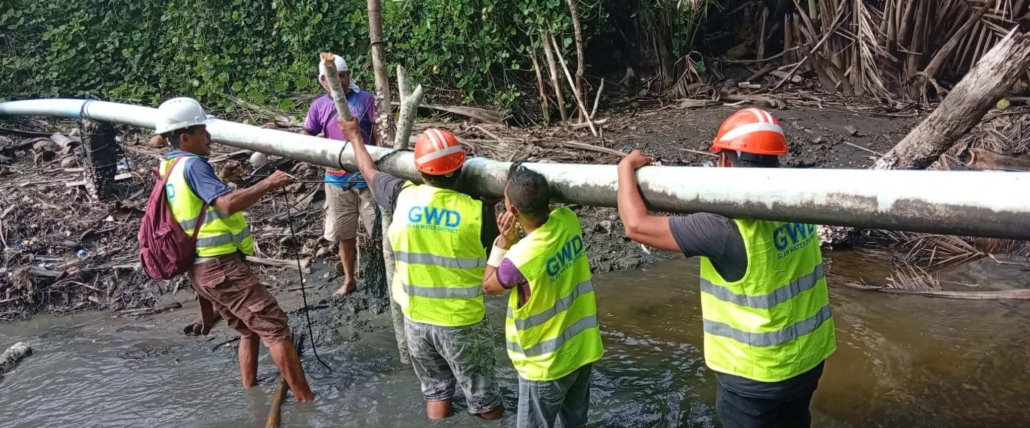
In Photo: In collaboration with Action Against Hunger, Glan Water District personnel repairs damages within the water systems of the Municipality of Glan following the earthquake. (Photo by Engel Merl De Villa for Action Against Hunger)
The Glan Water District prioritized the repair of damaged pipelines, recognizing that restoring the distribution network would provide the fastest relief to affected households. However, one major obstacle remained beyond the district’s financial capacity: the replacement of the damaged transformer.
Unfortunately, the Glan Water District had limited emergency funding available for such a major replacement.
It was during this critical period that Action Against Hunger began coordinating with the Glan Water District.
“From the beginning, they asked who managed the municipality’s water supply and immediately coordinated with us,” Glenda shared. “Together, we assessed the damaged facilities, identified the gaps, and discussed which interventions would have the greatest impact.”
The partnership quickly evolved into a coordinated early recovery effort.
Action Against Hunger supported the rehabilitation by providing two replacement transformers and implementing a series of water system repair and rehabilitation interventions with funding support from the Swedish International Development Cooperation Agency (Sida). Sida funding supported labor for the repair and restoration of damaged transmission and distribution pipelines, rehabilitation of the damaged roofing system at the Calabanit Filtration Plant, repair of the Banahao Filtration Box, and restoration of the Big Margus water system.
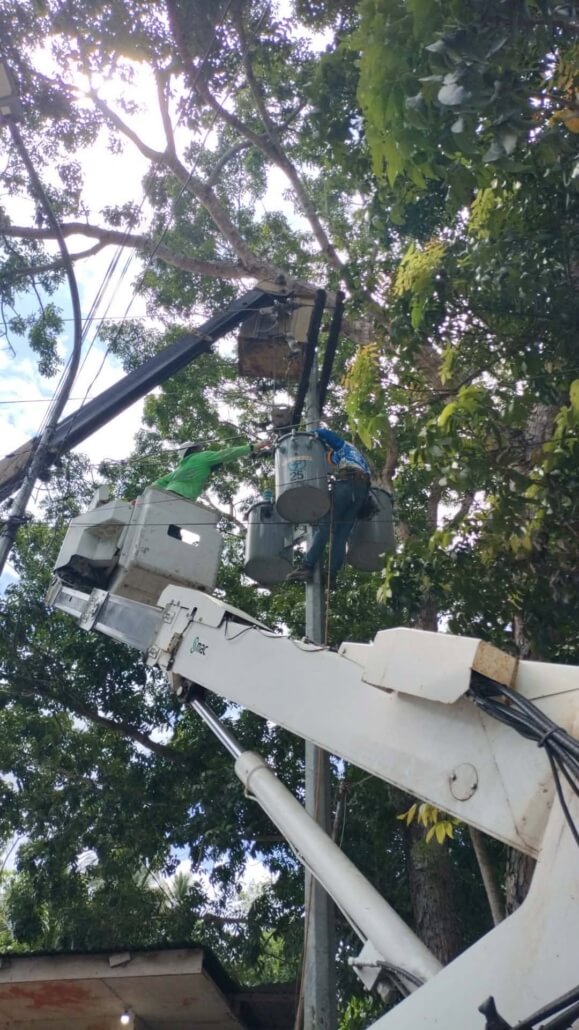
In Photo: Reparation of broken transformer underway (Photo by Engel Merl De Villa for Action Against Hunger)
Meanwhile, the Glan Water District contributed technical expertise, engineering supervision, human resources, co-financing the procurement of one transformer, and construction materials, including pipes, fittings, and accessories necessary to complete the rehabilitation works.
The South Cotabato II Electric Cooperative (SOCOTECO II) also played a vital role by facilitating the installation, testing, and energization of the replacement transformers, contributing to the restoration of electrical power to critical water supply facilities.
“The partnership worked because each organization contributed what it could,” Glenda explained. “Action Against Hunger provided resources we simply could not access immediately, while our technical team ensured that the repairs were implemented efficiently and according to engineering standards.”
The results were visible and felt almost immediately.
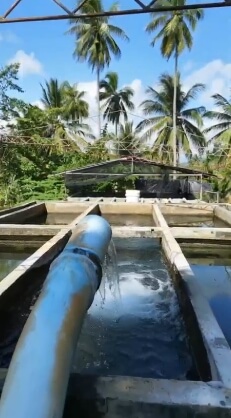
In Photo: Water flows in repaired water system in Glan (Photo by Engel Merl De Villa for Action Against Hunger)
Clean water in times of crisis
Following the repair of damaged pipelines along Atty. E. Yap Street and other sections of Barangay Poblacion, approximately 400 households regained access to water. Soon after, the installation and energization of the replacement transformers at the Calabanit Filtration Plant restored power to the booster pumps, allowing a total of approximately 1,100 households to reconnect to the water supply.
The restored pressure also enabled the technical expert from the water district to identify previously undetected leakages throughout the distribution network, allowing repair teams to continue restoring additional sections of the system.
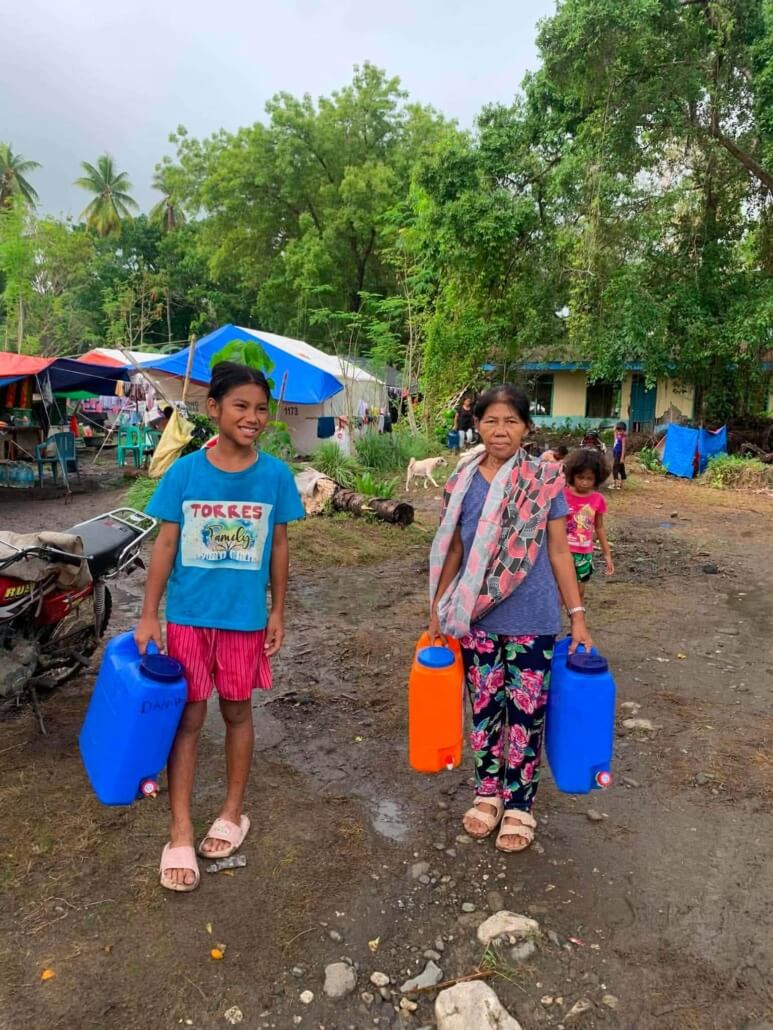
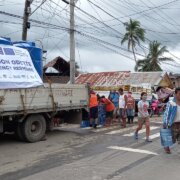
In photo: Two women carry water containers during the water trucking services provided by Action Against Hunger, in partnership with Glan Municipality during the early days of the earthquake’s aftermath, while the water system’s repairs were ongoing.
For the families who had spent days fetching water from distant collection points and carrying heavy containers back to their homes, the return of running water represented far more than the restoration of a public utility; it marked the beginning of recovery.
Among them Angelyn, 37, who lives with her five-member household in Purok Santan, Barangay Taluya─ one of the farthest points of the water distribution system.
After the earthquake disrupted their water supply, Angelyn, her husband, and her 63-year-old mother, Nanay Antonia, had to fetch water from a hand pump approximately 100 meters from their home, while purchasing drinking water from a nearby refilling station at fifteen pesos, or approximately 21-euro cents (€0.21) per container. Fetching and carrying water became a time-consuming and physically demanding part of their daily routine, with additional safety concerns when water had to be collected at night.
“It’s difficult when there’s no water at home. We have to go to the water pump and carry heavy containers of water. Fetching water also takes a long time, so it really adds to the exhaustion of our daily routine,” Angelyn shared.
With the restoration of the water system, the family once again has water available directly at home for cooking, bathing, washing clothes, cleaning, and other daily needs. Although water pressure occasionally remains low, having water within their home has reduced the time and physical effort required to collect it and has made it easier for the family to prepare for work and care for their children.
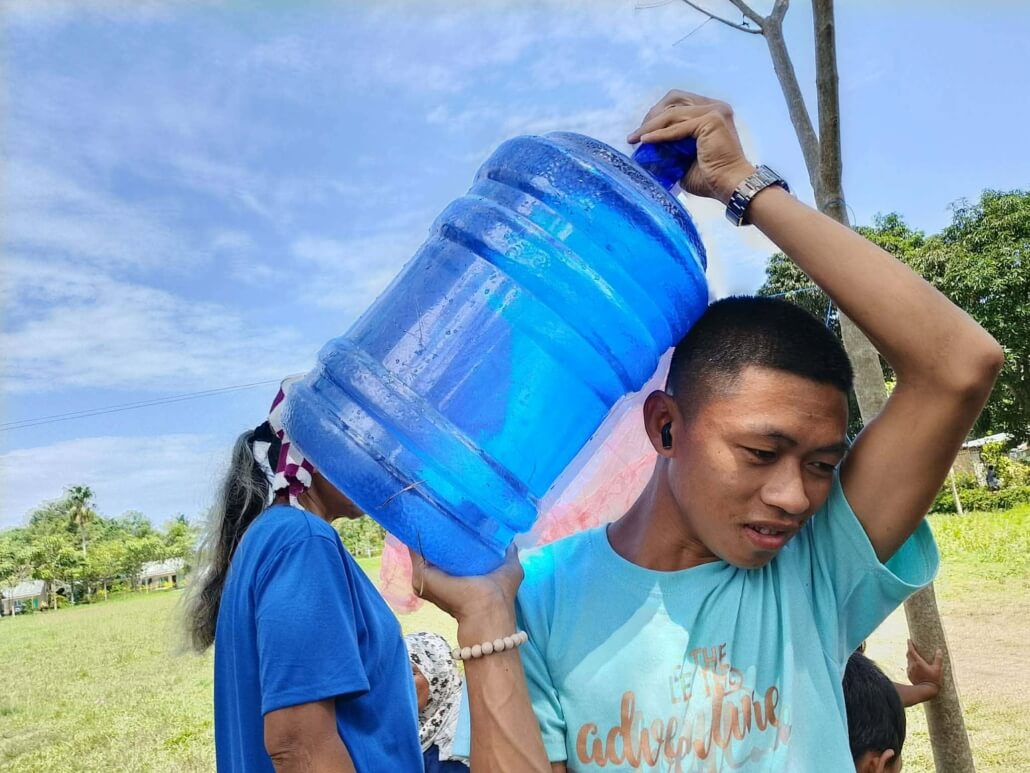
“Even when the water pressure is low at times, having water available at home makes a big difference. We no longer have to travel far to fetch water or carry heavy containers of water,” Angelyn added.
For Nanay Antonia, the restoration has also meant relief from the physical burden of fetching water and the additional household expenses associated with the disruption.
“Many thanks to Action Against Hunger and the Glan Water District for restoring our water supply. It has reduced the time, effort, and expenses we used to spend getting water.”
Glenda believes that without the timely intervention of Action Against Hunger, the municipality would have remained dependent on emergency water trucking for a much longer period, placing significant financial and logistical burden on both humanitarian responders and the local government.
“Without their support, many communities might still be waiting for water today,” she reflected. “The restoration happened much faster because we worked together.”
Among the many moments she remembers during the response, one stands above the rest.
“I felt relieved and grateful when the booster pump became operational again,” she said. “Even before the water reached every household, we already felt hopeful because we knew we were moving in the right direction.”
From crisis to action
For Glenda, the earthquake was not only a test of infrastructure but also a test of leadership, teamwork, and public service.
“We worked with both our hearts and our minds,” she reflected. “Our responsibility was to serve the people by restoring one of their most basic needs—safe water. That responsibility kept us moving despite all the challenges.”
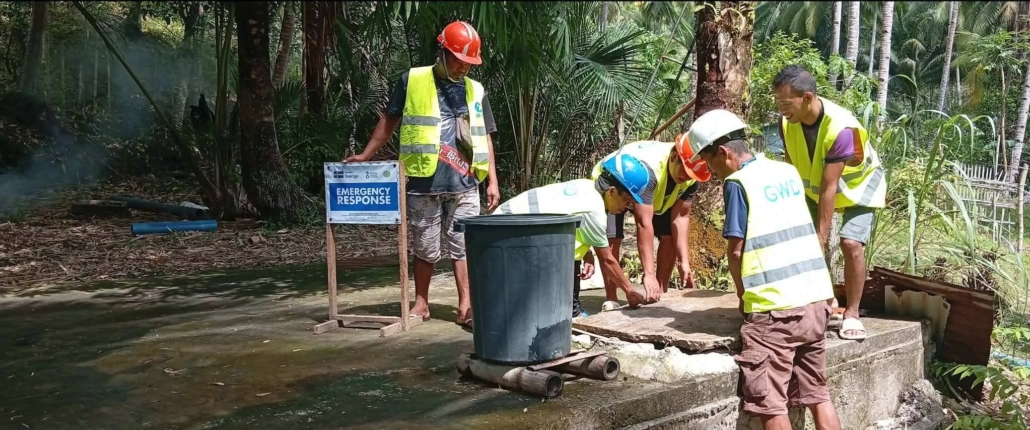
In Photo: In collaboration with Action Against Hunger, Glan Water District personnel repairs damages within the water systems of the Municipality of Glan following the earthquake. (Photo by Engel Merl De Villa for Action Against Hunger)
With the repair and restoration works in Big Margus completed and the water system operational, the Glan Water District continues to conduct leak detection and corrective repairs within the distribution network to progressively restore water supply to the remaining households in Big Margus and Small Margus. The overall rehabilitation experience has strengthened the water district’s commitment to disaster preparedness and reinforced the value of partnerships between local institutions and humanitarian organizations.
Glenda expresses her gratitude to everyone who stood beside the municipality during its most difficult days.
“This experience showed us that when organizations work together with one purpose, communities recover faster, and hope is restored along with the water.”
Author: Engel Merl De Villa
Edited by: Ana Nico Clement, Brian Kae Enriquez, Shiena Base, Joyce Sandajan