Tag Archive for: Siargao

Give to Gain: A Woman’s Commitment to Multiplying Impact

On Women’s Day, we highlight, through Wendie’s story, the power of reciprocity among women working to empower individuals toward change. When societies invest in women, opportunities expand, systems strengthen, and everyone benefits. Giving is not a loss when working with communities, but rather an intentional and powerful multiplication of impact.

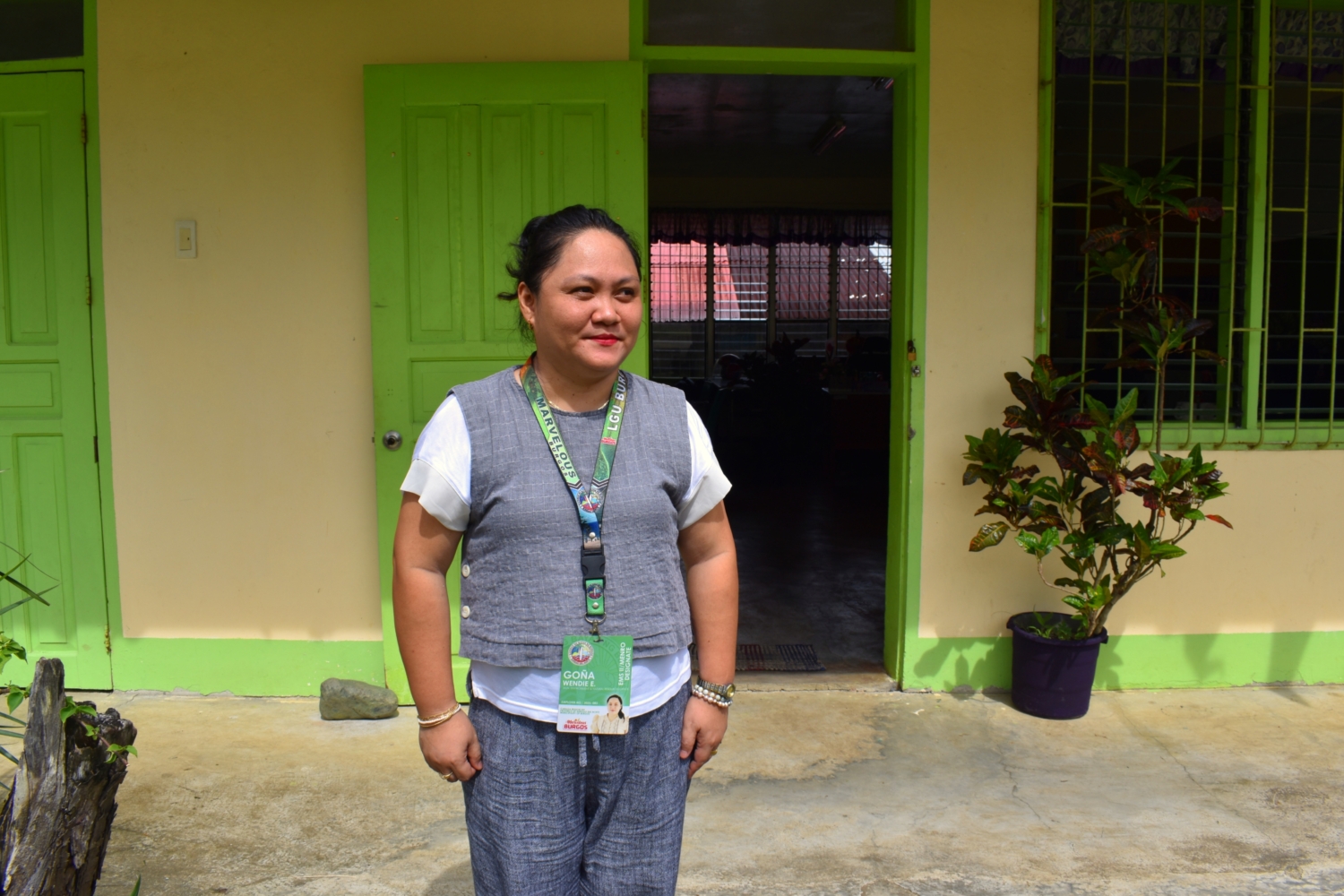
BURGOS, SURIGAO DEL NORTE – Wendie Goña, 38, is a dedicated champion of community-driven environmental protection in her municipality. Working as the Municipal Environmental Officer in Burgos,  Wendie has provided crucial support to Action Against Hunger initiatives in Siargao, such as the Siargao Green Economy Project, funded by the Spanish Agency for International Development Cooperation (AECID) and the Typhoon Odette WASH Recovery and Rehabilitation Towards Climate Resilience Programme together with UNICEF.

Wendie contributes to advancing programs at the local level, that protect forests, coasts, and marine ecosystems while empowering local communities, particularly women, to take an active role in safeguarding their environment.

Raised in Barangay Danawan, a small island community in Surigao City, Wendie experienced firsthand the challenges fishing families face during monsoon months. As the daughter of a teacher and a fisherman, she developed a deep respect for education and the natural environment, which inspired her to pursue a degree in Fisheries at Mindanao State University in Marawi City.

Over the years, she has worked tirelessly to organize self-help groups, lead mangrove rehabilitation projects, improve solid waste management, and implement climate adaptation initiatives.

Now living in Barangay Baybay, Burgos, Wendie works within a fifth-class municipality facing financial and logistical limitations, yet she continues to lead programs that integrate environmental responsibility, community engagement, and sustainable practices.

In this interview, she shares her journey, the lessons she has learned, her vision for empowering people within the community, and what it means to #GivetoGain in her daily life:

What inspired you to work on environmental protection?

I grew up on a small island, Barangay Danawan in Surigao City, as the daughter of a teacher and a fisherfolk. Life was not easy. During the monsoon, when fisherfolks could not go to sea and fishing was our main livelihood, many families struggled.

I soon realized how deeply we depend on the environment and that I had the power to create positive change in my community. From a young age, I knew I could use my voice and knowledge to empower others toward change. I have always been the type of student who speaks up when she realizes that something is not fair.

Many people have never experienced these challenging situations firsthand, so they often do not understand the difficulties involved. But if you are directly impacted, you know exactly what those struggles mean and how they can impact your daily life.
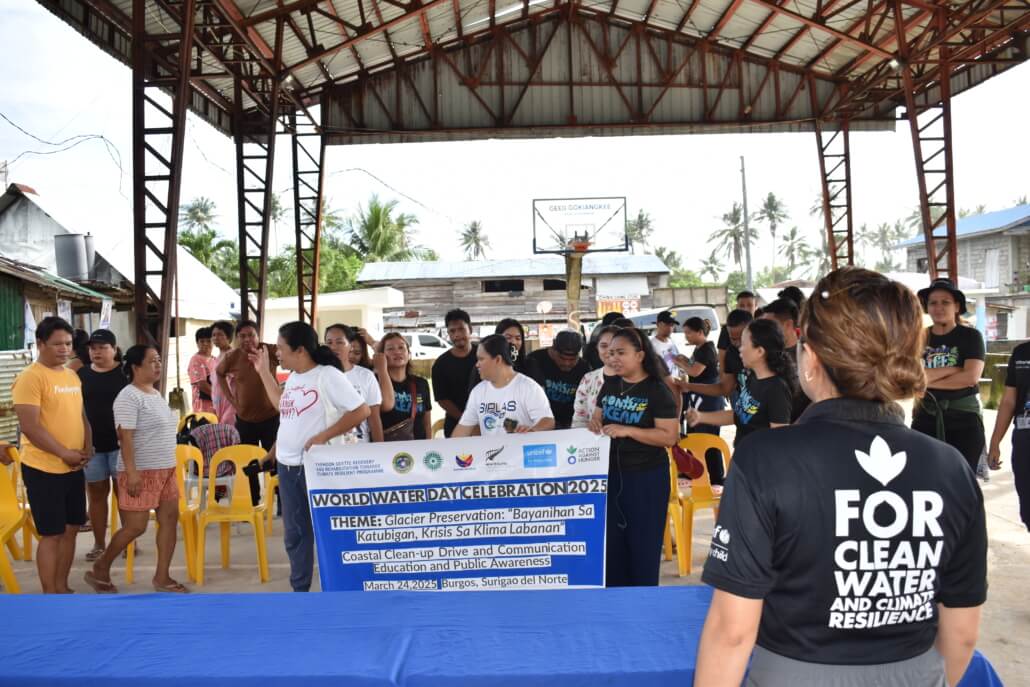
In photo: Wendie participates in the coastal clean-up organized by Action Against Hunger in 2025. Photo by Alexane Simon for Action Against Hunger


What is a typical day at work like for you?

My work involves implementing municipal environmental programs using a ridge-to-reef approach. This means we take care of the whole environment, from the mountains and forests down to the rivers, coast, and sea. What happens in the upland areas affects the water and life downstream.

For example, protecting forests helps prevent soil and dirt from going into rivers, keeping the water clean, and supporting healthy coastal and marine ecosystems.

I focus on forest management, solid waste management, protecting biodiversity, and adapting to and reducing the impacts of climate change.

Every day is different and challenging. I am not always in the office; sometimes I join community activities, such as awareness sessions on solid waste management. For example, I recently participated in an awareness campaign at Burgos National School under the Siargao Green Economy Project of Action Against Hunger.


What values do you bring every day on the job?

I am guided by the principles of change, integrity, accountability and  empathy. My advocacy extends beyond my job because protecting the environment is a shared responsibility.

I strive daily to create a positive impact across different communities, take responsibility for how my actions affect others, and let the experiences that have shaped me guide me to act with heart, both at work and in everyday life.
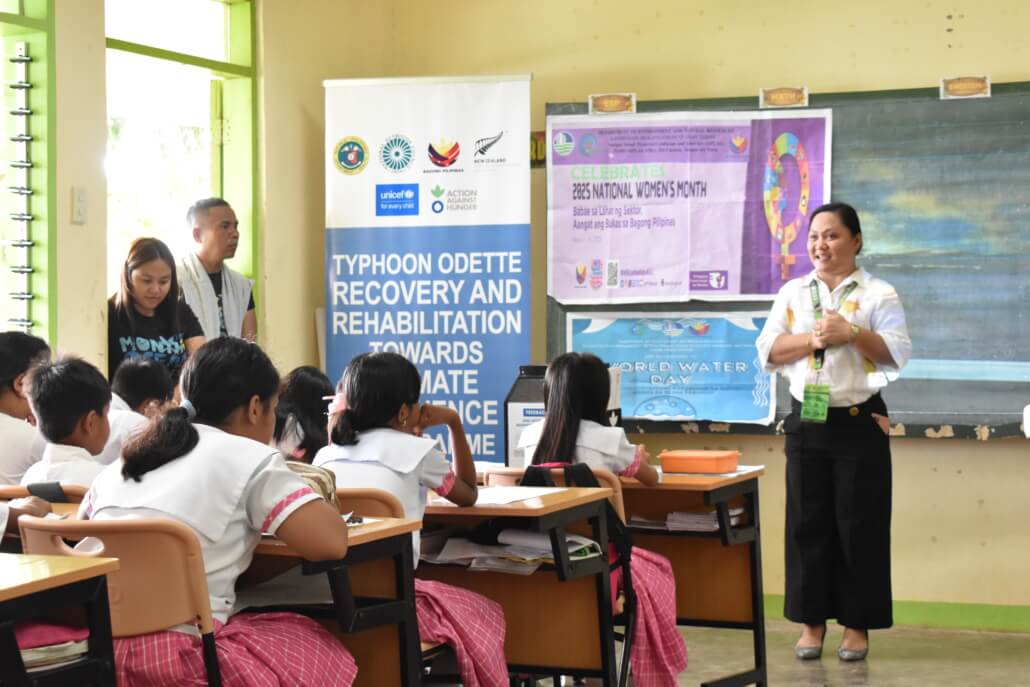
In photo: Wendie during a raising awareness session on environmental practices with students. Photo by Alexane Simon for Action Against Hunger.


Why is empowerment important in environmental work?

Empowerment is essential in environmental work because real, lasting change happens when communities have the knowledge, skills, and confidence to take action for themselves.

What I like most about working with my community is empowering women. Historically, women have had little voice in planning and decision-making, yet they are crucial for analyzing situations, understanding community needs, and providing unique perspectives. Women are natural and great leaders who guide, inspire, and take initiative they provide guidance, perspectives, and can inspire real change in their communities.

I support women in my office and community by sharing knowledge, building networks, and advocating for their representation in local governance. Women’s participation contributes to stronger  community efforts, especially in coastal cleanups, showing that when women are empowered, entire communities benefit.


What is something you wish could improve in your community?

One area I wish could improve in my community is solid waste management.

One of the most common issues among locals is improper waste segregation at the household level. To address this, I am proposing to the [local administration] the establishment of a new residual containment area, although this is challenging because the municipality is located within a protected area, so there are legal and environmental restrictions.

Nevertheless, the local administration is highly supportive of solid waste management initiatives.

One major challenge occurs when garbage trucks cannot operate for extended periods due to repairs. When waste is not collected on time, garbage accumulates, and some residents resort to dumping trash along roads. This is also why I promote social behavioral change initiatives, especially among young people or through door-to-door sensitization and actively participate in information and communication campaigns.

For me, the key is to focus on both soft enforcements, such as education and awareness, and hard enforcement, like penalties, to ensure there are no repeat violators. So far, I have seen that this approach works effectively within our community.


What challenges have you faced as a woman in your field, and how did you overcome them?

One challenge I have faced is gender bias. Back in college, many female fisheries students were sidelined from fieldwork because we were considered too fragile. I made it a point that we take part fully, recognizing that equal practical experience was essential for our professional growth.

Luckily, my family has been very supportive throughout my education and career. My father, a fisherfolk, has always been proud of my accomplishments and the challenges I have overcome, and his encouragement has been a constant source of strength for me.


What does “Give to Gain” mean to you in your work?

Give to gain” clearly reflects my approach to work. When you give your time, knowledge, and effort sincerely to the community, you gain trust, engagement, and lasting impact in return. By mentoring, educating, and empowering others, especially women who are often hesitant to speak up, you help communities develop the capacity to sustain change themselves.

Environmental conservation is a shared responsibility, and embracing a give to gain mindset creates a win-win situation, ensuring growth and benefits for both the community and the programs we implement.
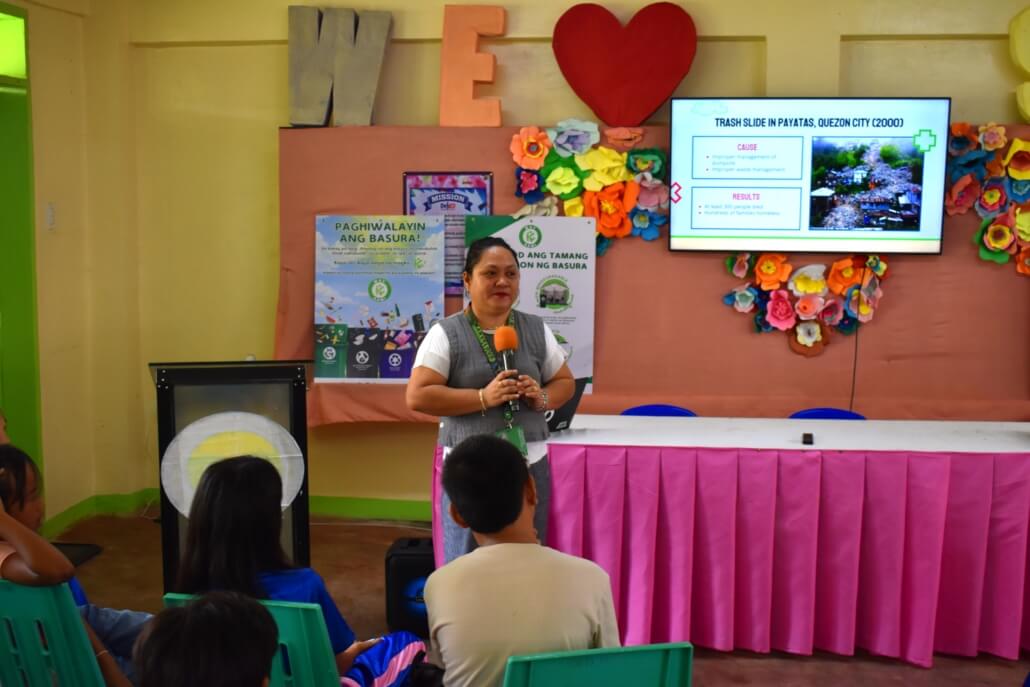
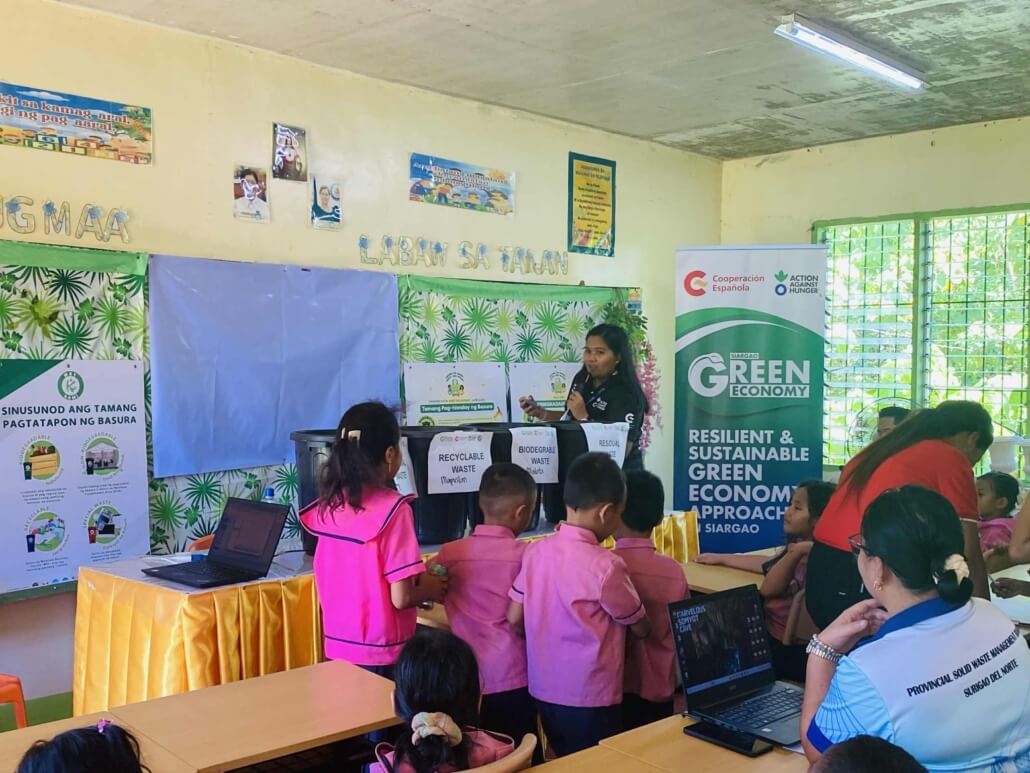
In photo: Wendie during a raising awareness session on waste management with students in Burgos. Photo by Martina Vercoli for Action Against Hunger.


What have you gained personally and professionally by working with the communities?

By working with the communities for many years now, I have gained resilience, patience, and stronger leadership skills. By resilience, I mean the ability to keep going despite challenges, limitations, or difficulties in my work and community projects.


Can you share a specific moment when giving made a difference?

It was not a single moment but an ongoing process. Through advocacy and enforcing local ordinances on solid waste management, we saw people follow the rules more consistently. In the Philippines, many environmental laws exist, but the struggle is in ensuring that we are strongly enforcing them.

Even more inspiring was when communities became proactive and took action on their own, showing that giving guidance truly makes a difference.

I work closely with my team and the community to empower change. For example, seeing women in my team take leadership in enforcing local ordinances or participate actively in cleanups is very heartwarming. It shows that our efforts are influencing the next generation of environmental accountability.
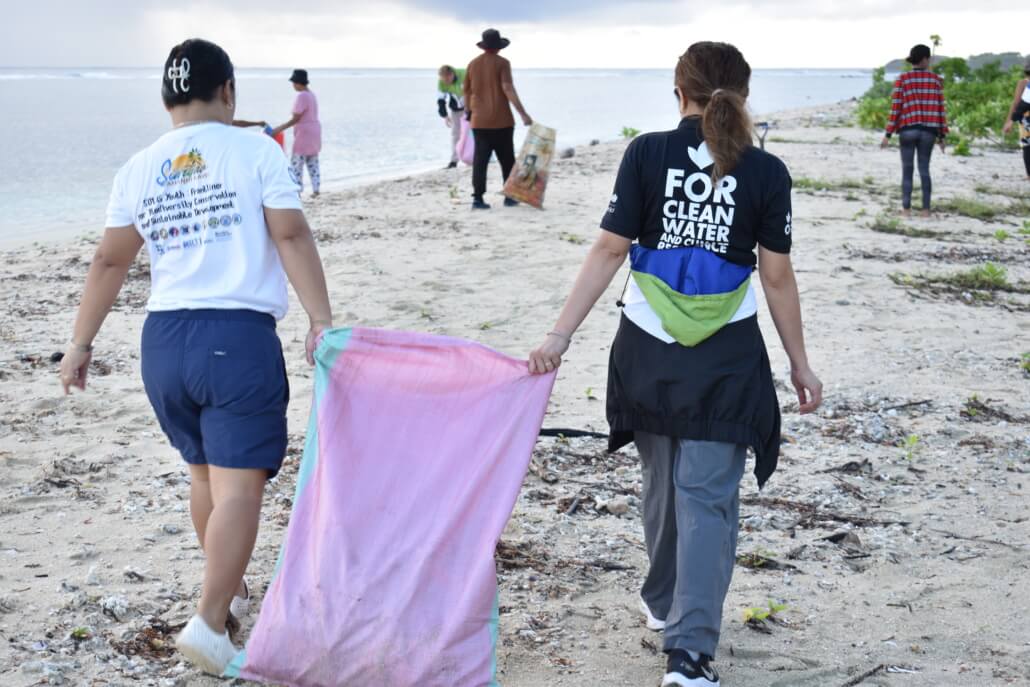
In photo: Wendie (left) and Action Against Hunger staff work together in collecting trash during the World Water Day 2025. Photo by Alexane Simon for Action Against Hunger


What is something a woman or girl has taught you?

Women who have crossed my path have taught me that leadership does not always require formal titles. Even without official recognition, women’s groups at the community level can be highly organized and effective.

In Burgos, they lead cleanups, mobilize neighbors, and sustain environmental initiatives quietly and powerfully.

Wendie’s story reminds us that true impact is not measured by individual accolades but by the ripple effects of giving. By investing her time, knowledge, and energy in her community, especially in empowering women, she multiplies change in ways that endure beyond her daily work.


On this International Women’s Day, her example inspires us to recognize that when women lead, support, and mentor others, the gains extend far beyond themselves, shaping stronger, more resilient communities for everyone.
Building a Zero-Waste Future Starts with Awareness, and with Children

SURIGAO DEL NORTE ─ As January closes and Zero Waste Month in the Philippines comes to an end, communities in Siargao Island are reflecting on a simple but important lesson: building a resilient, green economy begins with awareness, and it needs to start early.

In island communities facing increasing climate risks, unmanaged waste affects daily life in tangible ways. It blocks drainage systems, contributes to flooding during heavy rains, threatens public health, and complicates disaster preparedness efforts. These realities explain why the Siargao Green Economy Project places solid waste management at the center of its climate resilience and green economy approach, focusing not only on systems and policies, but also on everyday practices and decision-making at the community level.

Why waste awareness matters for climate resilience

Improving solid waste management is one of the most direct ways communities can reduce environmental and disaster risks. When waste is not properly segregated or disposed of, it often ends up in waterways and low-lying areas, increasing flood risks during typhoons and periods of intense rainfall. For island municipalities like those in Siargao, these impacts are felt more frequently as climate conditions become less predictable.

Addressing these risks requires more than infrastructure. It requires changes in how people understand waste and how they manage it in their homes, schools, and communities.

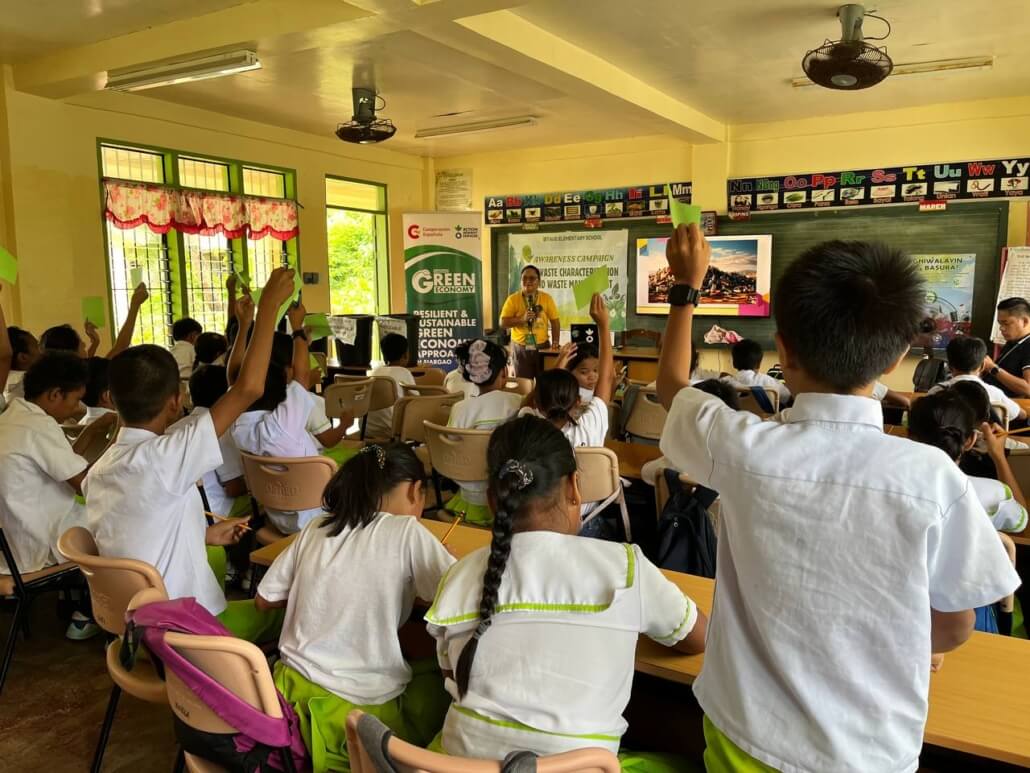
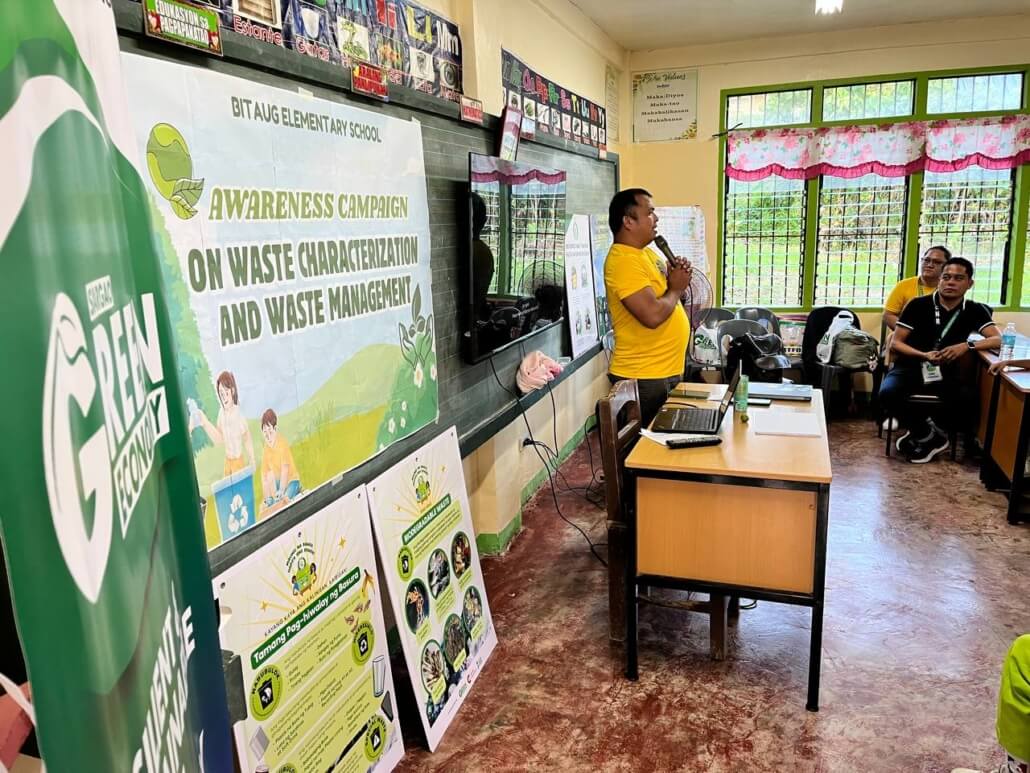
In support of the national Zero Waste Month theme, “R.A. 9003 at 25: Honoring our Past, Renewing Commitments, Innovating for a Cleaner Tomorrow,” Action Against Hunger, through the Siargao Green Economy Project conducted an awareness campaign on Waste Characterization and Management as part of the project’s behavior change and communication strategy. The campaign incorporated discussions on disaster risk reduction, climate change adaptation, and gender equality, reflecting the project’s integrated approach to resilience and sustainability.

What is R.A. 9003?

Republic Act No. 9003, or the Ecological Solid Waste Management Act of 2000, provides the legal framework for solid waste management in the Philippines. It emphasizes waste reduction at source, segregation, recycling, composting, reuse, and resource recovery, while prohibiting incineration.

The law places responsibility on local government units and encourages participation from communities and the private sector. It also highlights the role of education and public awareness by integrating waste management principles into both formal and non-formal learning settings.

Source: Philippine Environment Partnership Program, Department of Environment and Natural Resources

Inside the Awareness Campaign

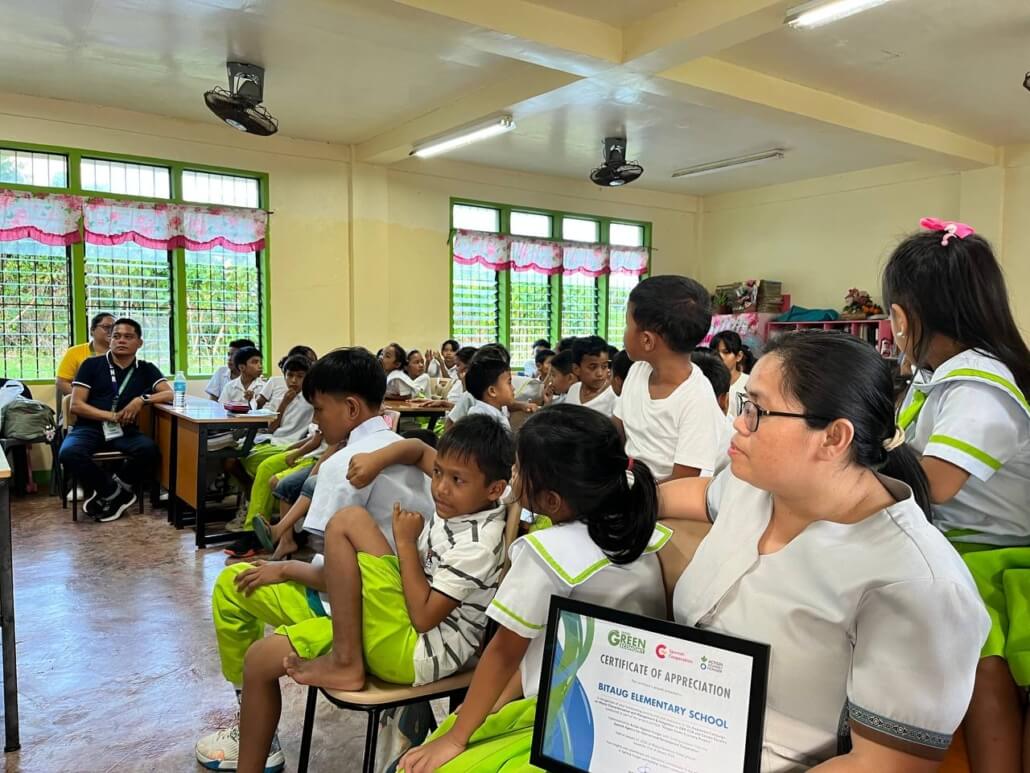
The campaign reached elementary students, teaching and non-teaching staff, and barangay representatives in Barangays Baybay, Matin-ao, San Matero, and Bitaug in Burgos, Surigao del Norte, through activities conducted on January 20 to 21, 2026. The sessions were implemented with support from the Municipal Environment and Natural Resources Office (MENRO) and the Department of Environment and Natural Resources Environmental Management Bureau (DENR-EMB).

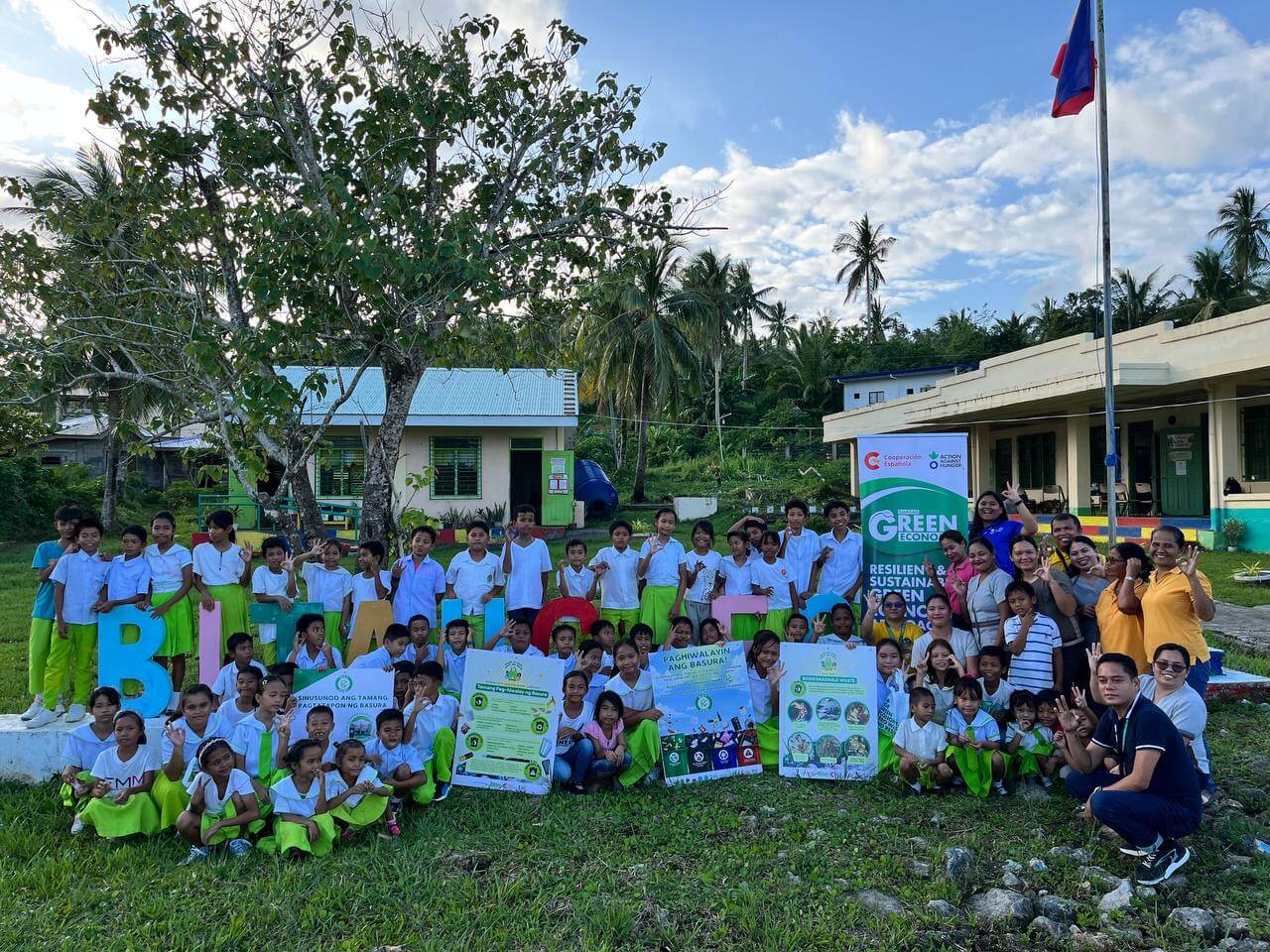
During the sessions, students were introduced to waste characterization and management, the key provisions of Republic Act No. 9003, and the basic principles of the circular economy. Facilitators used examples familiar to the students, such as common household and school waste, to explain how waste can pose risks when unmanaged and how some materials can still have value when properly segregated and reused.

Students participated in pre- and post-test activities, where they identified different types of waste and practiced classifying them into appropriate categories. These exercises surfaced a shared realization among many students: waste is not a single category, and each type carries different environmental, health, and safety implications.

A short quiz followed, during which students shared their answers aloud and discussed them with classmates and facilitators. Questions raised during these exchanges allowed facilitators to clarify concepts related to segregation, disposal, and the links between waste management and disaster risks.

The campaign also included a creative activity, where students produced posters and slogans inspired by the Zero Waste Month 2026 theme. Through drawing and short messages, students expressed how they understood waste reduction and environmental responsibility. Selected outputs will be refined and used in future Information, Education, and Communication materials, extending the reach of the activity beyond the schools.

Why start with children?

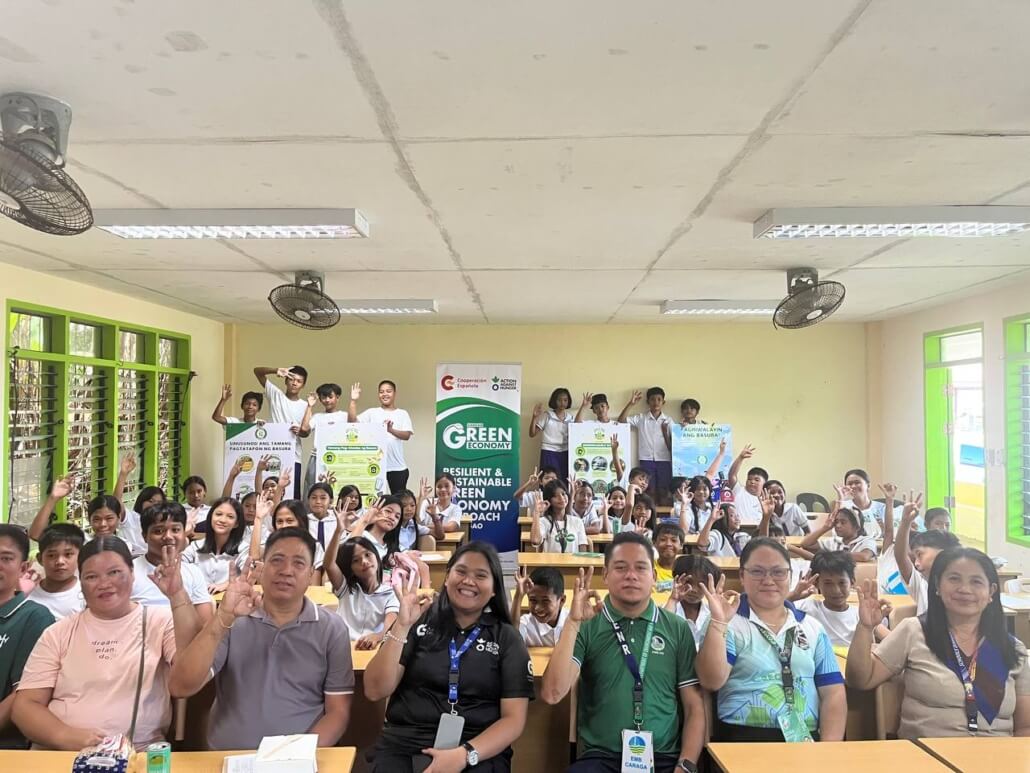
In photo: Florencio Betonio, Jr. of Barangay Bitaug and the students of Bitaug Elementary School. (Photo by Conie Isabel Ann Canto for Action Against Hunger)

Engaging children is a deliberate choice. Schools are spaces where habits and values are formed early. By introducing students to waste classification, segregation, and the links between waste, flooding, and health, the project works toward changes that can influence both school environments and household practices over time.

Teacher Marysol Astorbia, Head Teacher and School-in-Charge of Bitaug Elementary School, shared her perspective on the activity:

“School is not only a place for learning but also a home for discipline and responsibility. Through proper waste management, students learn the value of cleanliness, order, and care for the environment. This is a significant step toward a well-managed school.”

She also noted that revisiting waste management concepts helped reinforce lessons that students may have encountered before, underlining the need for regular and consistent awareness activities.

In photos (from left) are Mr. Racky Dryn D. Buenavista, students of Bitaug Elementary School and Ma’am Marysol A. Estorbia, Head Teacher-I/ School-In-Charge (Photo by Conie Ann Isabel Canto)

Did You Know?

    • Mismanaged solid waste can increase flood risks by blocking waterways, particularly in coastal and island municipalities. The Philippines generates approximately 35,580 tons of waste daily. According to the Solid Waste Management Status Report (2008–2018), waste generation reached 18.05 million tons in 2020 and is projected to increase to 23.61 million tons by 2025. (Source: Climate Transparency Platform)
    • Children often bring waste management practices learned in school back to their households, influencing how families manage waste at home. According to the World Bank, solid waste management systems often succeed or fail because of how people behave, not simply because of the technology in place. Practices such as segregation, recycling, composting, and waste reduction are shaped by people’s knowledge, attitudes, social norms, convenience, and the incentives available to them.

Awareness as a Foundation for Action

The campaign also highlighted the role of local leadership in sustaining waste management efforts. Barangay representatives participated alongside students and school staff, reinforcing the idea that responsibility for waste management extends beyond individual households.

“Awareness is the first step toward positive change,” shared Florencio Betonio, Jr., a representative of Barangay Bitaug. “What we have learned today should not end here. It should guide our actions, influence our decisions, and encourage us to share this knowledge with others.”

This perspective reflects the project’s approach, where awareness informs behavior, behavior supports systems, and functioning systems contribute to community resilience.

Linking waste management to a Green Economy

The Siargao Green Economy Project goes beyond waste reduction alone. It supports the development of circular economy solutions, strengthens local governance, and engages communities, women, and private sector actors in building resource-efficient and climate-resilient local economies.
By integrating gender equality, disaster risk reduction, and climate change considerations into waste awareness activities, the project situates environmental action within everyday community realities.

As Zero Waste Month comes to a close, these efforts continue. Awareness campaigns such as this contribute to stronger waste management practices, safer communities, and a future for Siargao where environmental responsibility is part of daily life, beginning at a young age.


About the Project

The Siargao Green Economy Project is implemented by Action Against Hunger Philippines with funding from the Spanish Agency for International Development Cooperation (AECID).

The project fosters climate resilience and green economies in Siargao Island through inclusive, gender-transformative governance, strengthened solid waste management systems, and circular economy initiatives—supporting communities in building a more sustainable and resilient future.

Typhoon Drill Strengthens Community Preparedness in Del Carmen’s Island Barangays

SIARGAO — On November 20, 2024, Del Carmen, Surigao del Norte, took a significant step toward building resilience and safeguarding lives with its first-ever community typhoon simulation drill.

In photo: Residents participate in the typhoon emergency evacuation drill.

Conducted simultaneously in the island barangays of Caub, San Fernando, and Domoyog, the activity—organized under the Resilient IsLA Project—engaged 25 households per barangay along with the Barangay Disaster Risk Reduction and Management Committees (BDRRMCs). This hands-on exercise aimed to enhance disaster preparedness and strengthen the community’s capacity to respond to future emergencies.

Photo by Mark Dalin-as for Action Against Hunger

The simulation brought together a wide network of local agencies, including the Municipal Disaster Risk Reduction and Management Office (MDRRMO), Municipal Planning and Development Office (MPDO), Municipal Health Office (MHO), Philippine National Police (PNP), Bureau of Fire Protection (BFP), Philippine Coast Guard, Municipal Engineering Office, Municipal Social Welfare and Development Office (MSWDO), Municipal Agriculture and Fisheries Office (MAFO), and the Rural Health Unit (RHU). Their collaboration demonstrated the importance of unified, multi-sectoral efforts in protecting vulnerable communities.

In photo: Simulation of providing first aid to emergency victim. Photo by Rasul Abdullah for Action Against Hunger

For many residents and local officials, the drill was a transformative experience beyond simulation. It exposed critical gaps in current preparedness strategies and empowered participants to address these vulnerabilities proactively. Reflecting on their experiences during Typhoon Odette, many community members expressed heartfelt gratitude to Action Against Hunger for organizing the activity. “This was a valuable opportunity for us to learn and prepare,” shared one participant. “It’s our first time doing a drill like this, and now we feel stronger and more united as a community.”

Photo by Mark Dalin-as for Action Against Hunger

The exercise underscored Action Against Hunger’s core advocacy: ensuring that the most vulnerable communities are equipped with the knowledge and tools to withstand disasters. By focusing on preparedness from the household level to barangay and municipal offices, the drill highlighted the importance of coordination, resource mobilization, and effective response strategies.

This initiative is part of the broader Disaster Risk Reduction and Climate Change Adaptation (DRR-CCA) efforts under the Resilient IsLA Project, funded by the United States Agency for International Development’s Bureau for Humanitarian Assistance (USAID-BHA). The project aims to strengthen community resilience through capacity-building and practical preparedness activities, ensuring that no one is left behind when disaster strikes.

Photo by Andro Petallar for Action Against Hunger

The success of this drill marks a crucial step toward fostering safer, more resilient communities in Del Carmen. It also serves as an inspiring model for other barangays in the municipality, demonstrating the power of collective action and community-driven preparedness in the face of growing climate challenges.

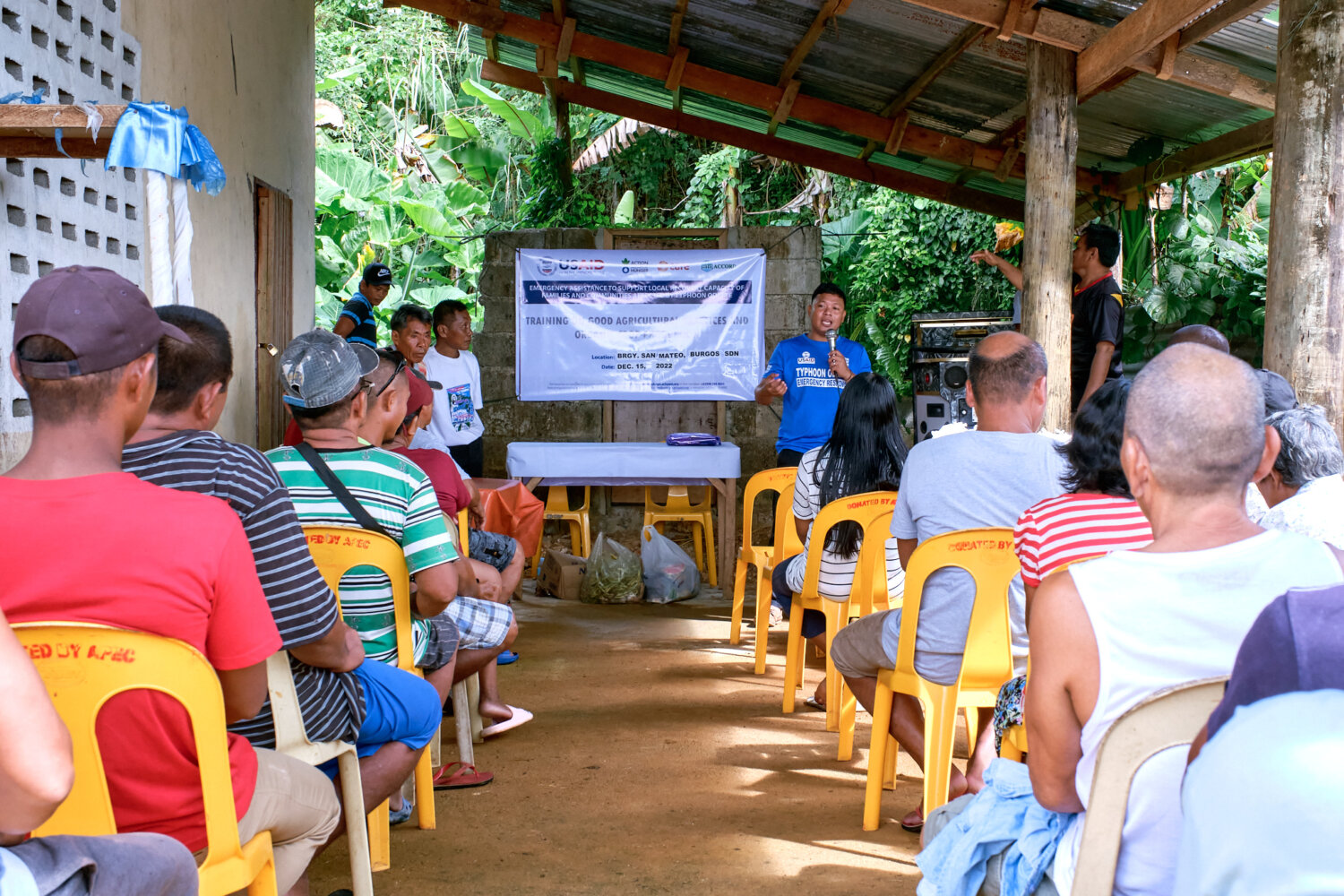
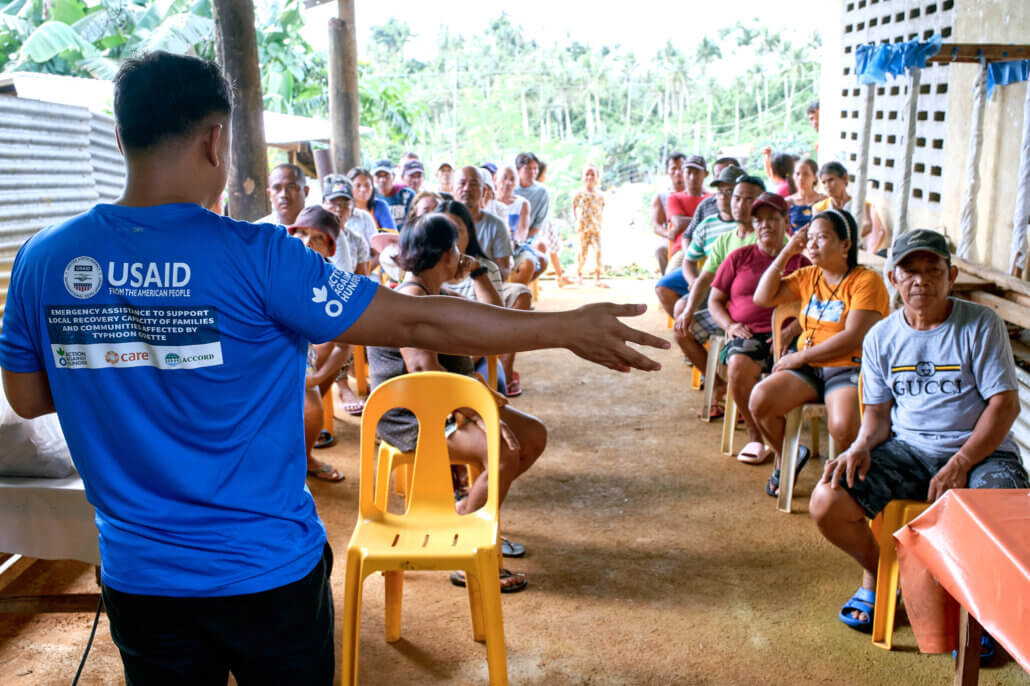
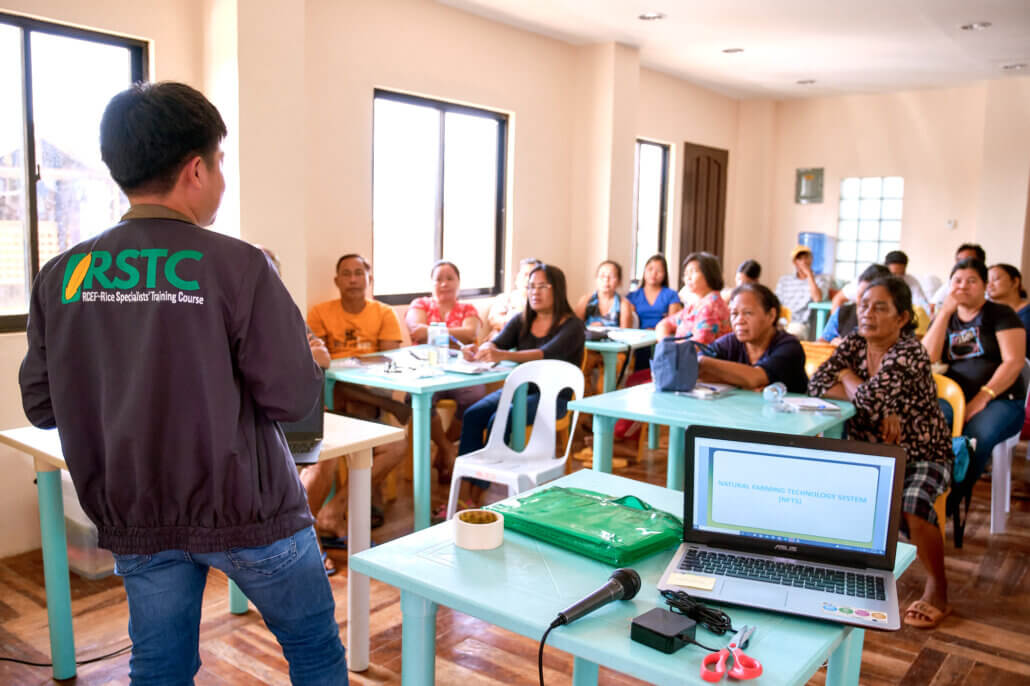
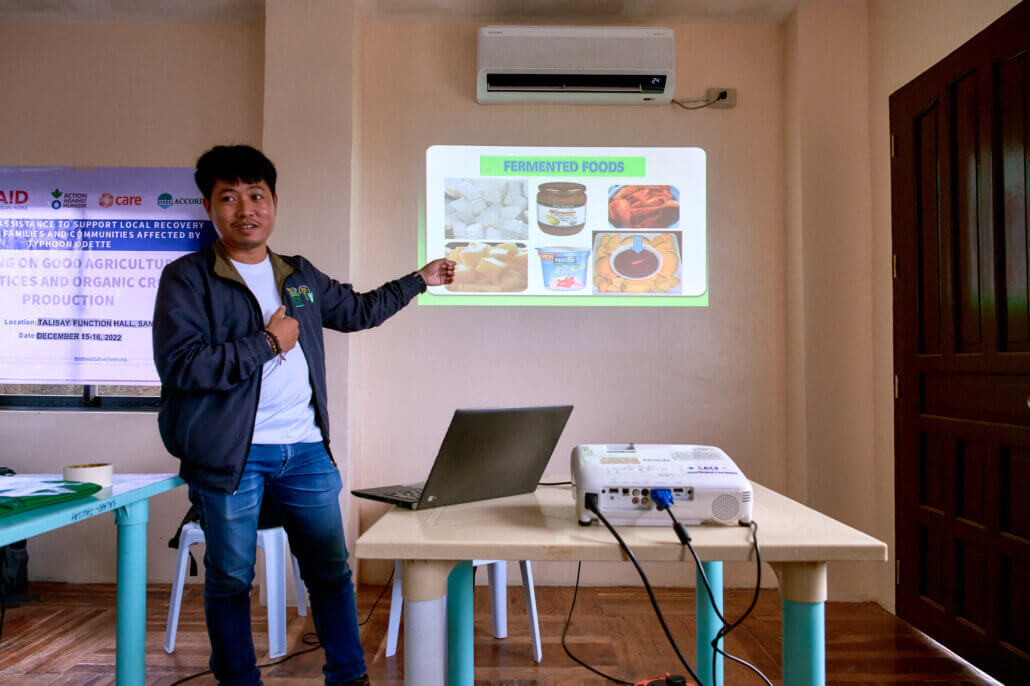
Siargao Farmers Trained on Good Agricultural Practices and Organic Farming

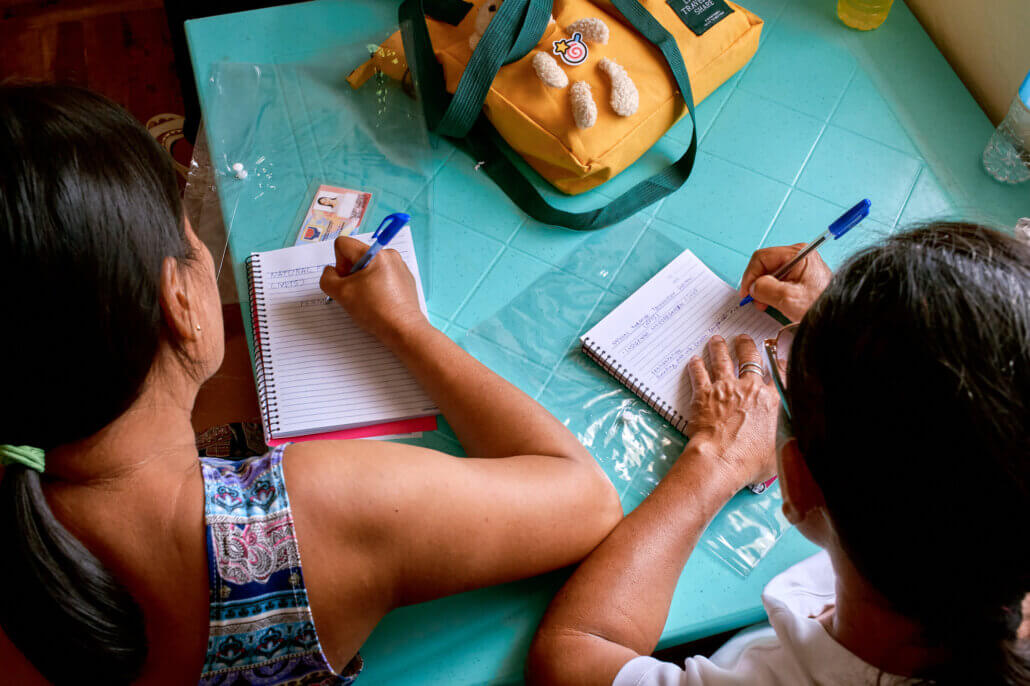
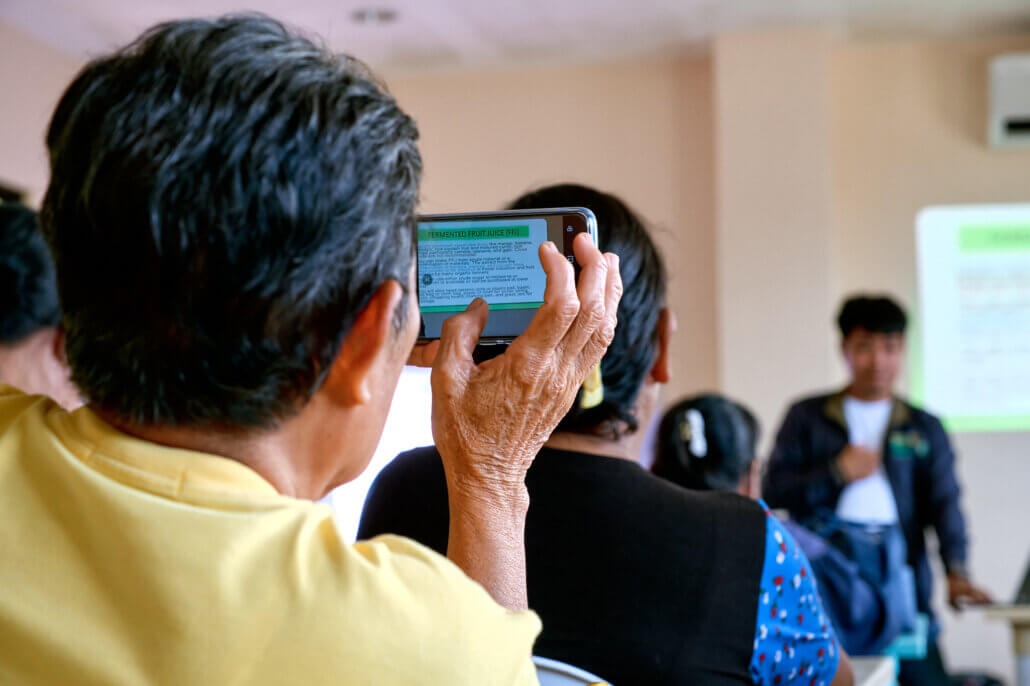
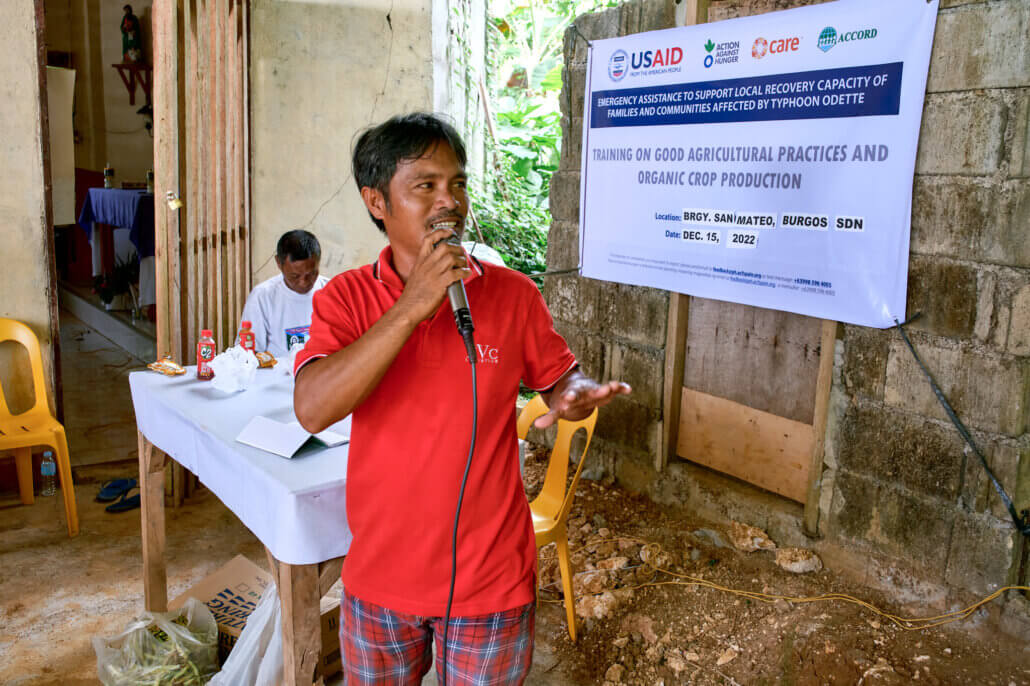
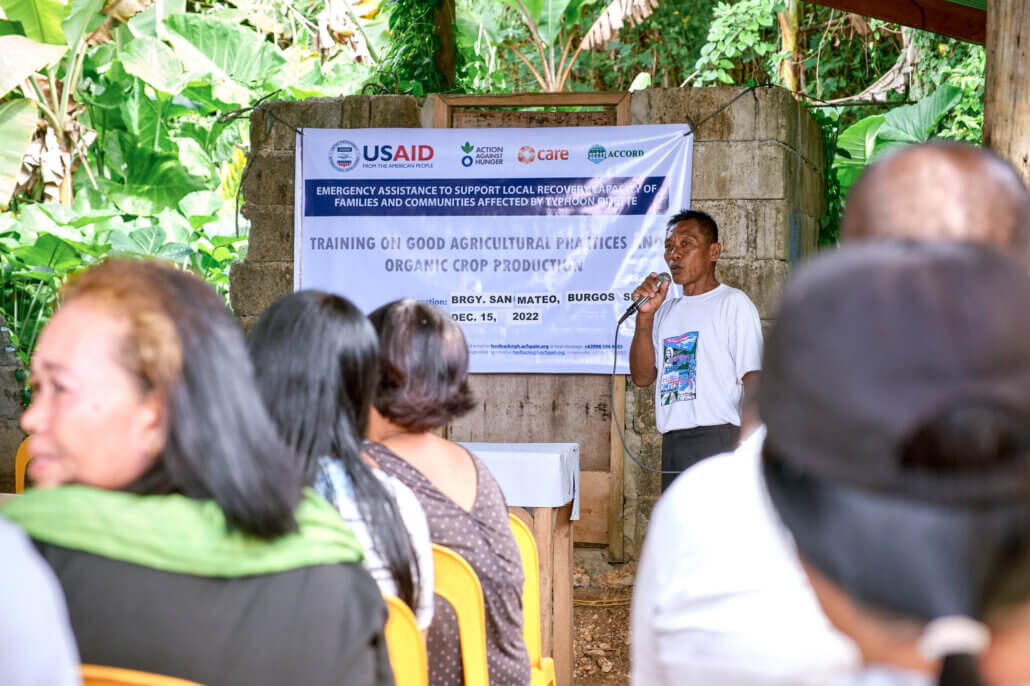
Farmers affected by Typhoon Odette attended a farmer training on Good Agricultural Practices and Organic farming in the municipalities of San Benito and Burgos on the island of Siargao, Surigao del Norte last December 2022.

The training is facilitated by trainers from the Rice Specialists Training Course (RSCT). The participants from barangays Orok and Talisay learn approaches on how to rebuild their agricultural livelihoods and increase their farm yields through sustainable and safe methods.

Among other things, they learn about the importance of intercropping and how to make and apply organic fertilizers and pesticides. They also learned how to transfer their newfound knowledge to others.

After the training, they will facilitate sharing what they learned with other farmers in their communities.

Photos by Arianne Gijsenbergh for Action Against Hunger | December 2022, Siargao, Surigao del Norte

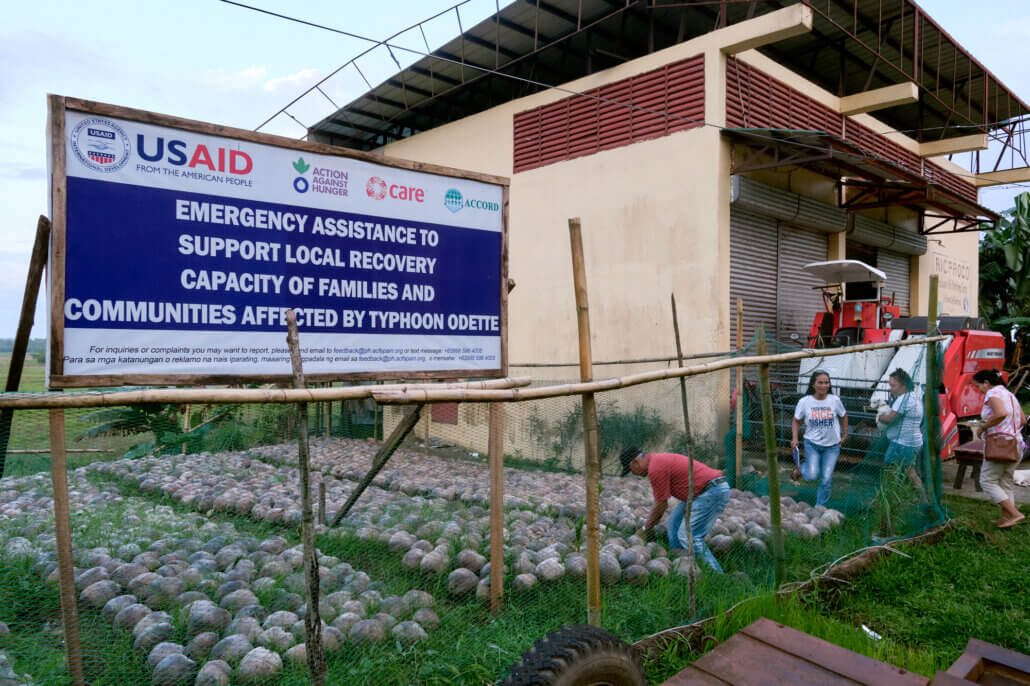
The livelihood support is part of the second phase of the project ‘‘Emergency Assistance to Support Local Recovery Capacity of Families and Communities Affected by Typhoon Odette’, funded by the United States Agency for International Development’s Bureau for Humanitarian Assistance (USAID-BHA) and jointly implemented by Action Against HungerCARE Philippines, and ACCORD Incorporated.


Written by Arianne Gijsenbergh Read more

Restoring the Rice Fields After Typhoon Odette

CAPALAYAN, SURIGAO CITY — Erna Crisologo, 35, is proud to be a rice farmer. Growing up in a family of rice farmers she has lived in the middle of the rice fields her whole life. Besides the rice field bordering their home, Erna and her husband Ruben Cabalan, 35, also own a small coconut plantation higher up the mountain.

The rice paddy near Erna and Ruben’s home. (Photo by Arianne Gijsenbergh for Action Against Hunger | Surigao City, December 2022)

In December 2021, Typhoon Odette raged across the Philippines leaving a trail of destruction along its path. Erna and Ruben’s home in barangay Capalayan, a rural area on the outskirts of Surigao City, was completely washed away, along with their rice plants and coconut trees.

Erna joined the livelihood training sessions and received cash assistance to restore her family’s livelihood. This was part of the Typhoon Odette Emergency Response implemented by Action Against Hunger in the province of Surigao del Norte with funding support from the United States Agency for International Development’s Bureau for Humanitarian Assistance (USAID-BHA),

“Our rice plants were totally washed away, our coconut trees damaged. We had no more source of income, no source of food.”

In the aftermath of the typhoon, Erna, Ruben, and their daughter Shekanaiah, 8, found shelter in the school nearby. The school functioned as an evacuation center. The first days after the storm, the situation was dire. The center was overcrowded and the families were hungry. It took almost a week for food supplies and other relief goods to arrive because the roads were unpassable.

With no home to return to, Erna and her family stayed in the evacuation center for 2 months. “I was very stressed that time due to our situation,” recalls Erna, “Our rice plants were totally washed away, and our coconut trees damaged. We had no more source of income, no source of food.”

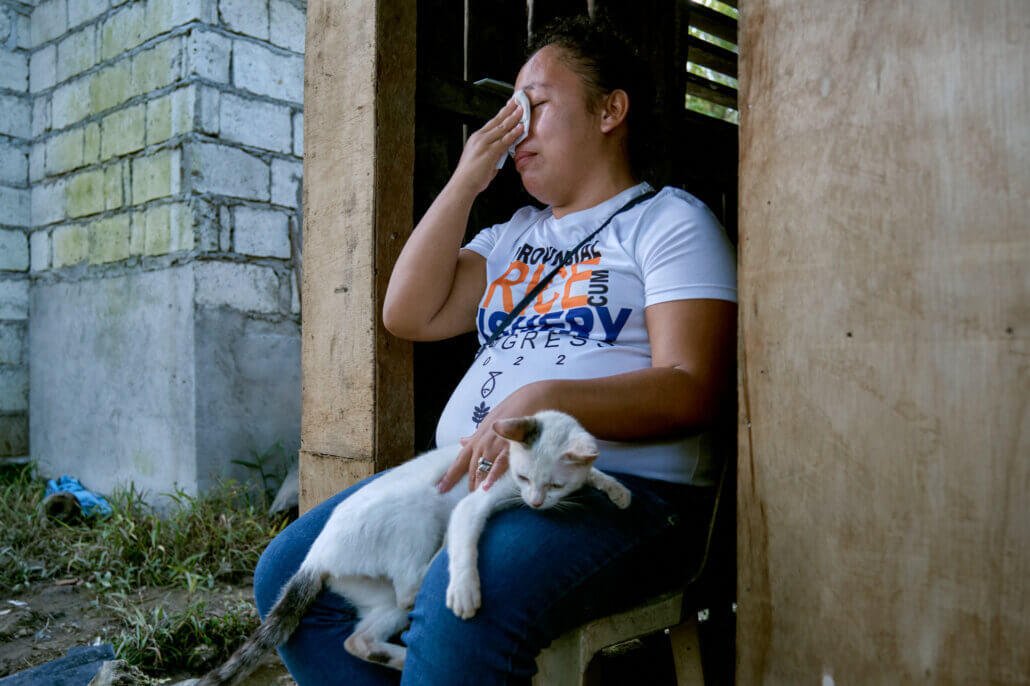
Erna cries as she recalls their experience during and after Typhoon Odette (Photo by Arianne Gijsenbergh for Action Against Hunger | Surigao City, December 2022)

Erna was heavily pregnant with a second child, which was due in February. Sadly, the stress took a toll on her body. On January 23 Erna had a miscarriage. “My baby is over there,” says Erna through her tears, pointing at a small grave next to the rice field. “That’s where we buried him. A boy. We named him Anton.”

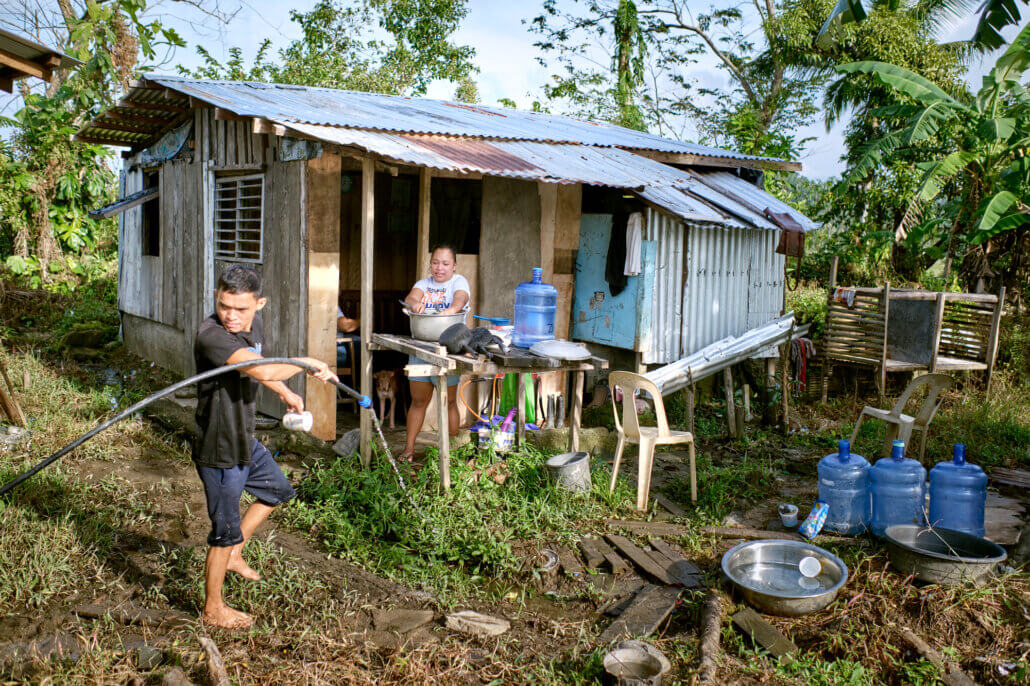
Thankfully, there was light at the end of the tunnel. Erna’s family received donated housing materials, which they combined with leftover planks from their old house to build a new home.

The newly-repaired home of Erna and her family. (Photo by Arianne Gijsenbergh for Action Against Hunger | Surigao City, December 2022)

Once her family had a roof over their heads again, Erna and other typhoon-affected farmers in barangay Capalayan attended a training on good agricultural practices and organic vegetable production, organized by Action Against Hunger. Erna learned how to make and apply organic insecticide and fertilizer and how to improve their dyke construction. “Before we were making our dykes larger and higher,” explains Erna, “but the trainer told us that if you make the dyke too big, it will attract mice who will make it their home. It should be like this, just high enough to prevent the water and fertilizer from flowing away.”

Erna also joined a training on financial literacy and wrote a business plan to access 15,000 pesos cash assistance. She used the funds to buy a tools like sprayer for the organic fertilizer, a shovel, a raincoat, rubber boots, organic rice seeds and to pay for labor costs for land preparation.  “I feel very happy and excited to start planting rice again,” says Erna.

“I learned that it is very important to save so that we will not be hungry if a disaster comes. We are very thankful that Action Against Hunger gave us funds to restart our business. Now we have no debts to repay and we can start saving immediately.”

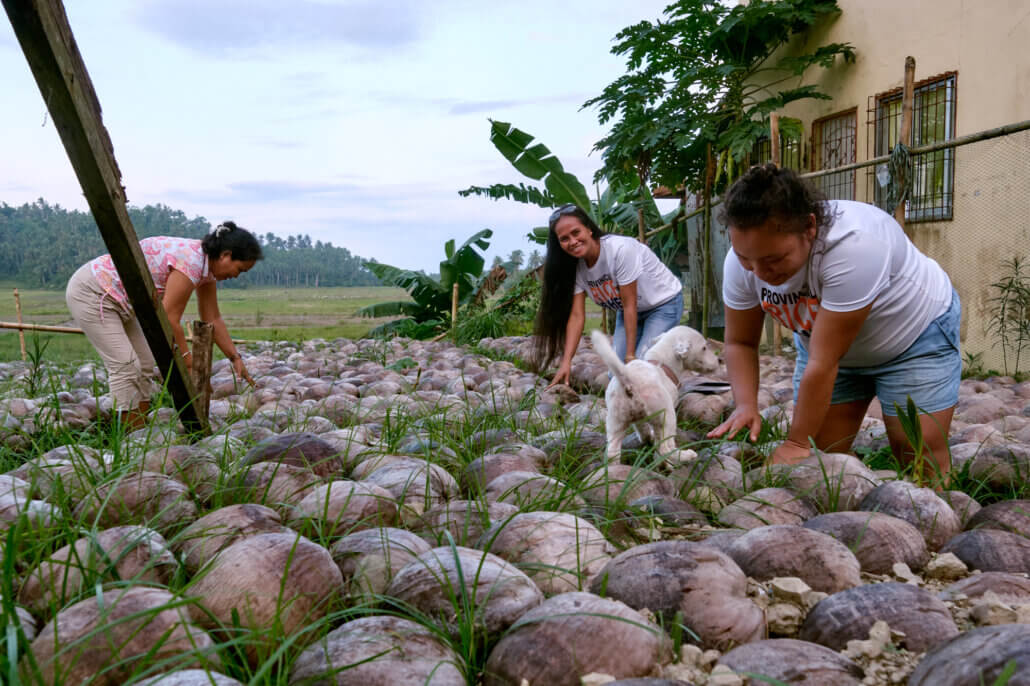
In addition to the training sessions and cash assistance, Action Against Hunger coordinated with the Philippine Coconut Authority to provide seed nuts to the farmers for restoring their coconut plantations. Erna and the other beneficiaries take turns weeding and watering the seed nuts in the nursery until they are ready for transplanting.

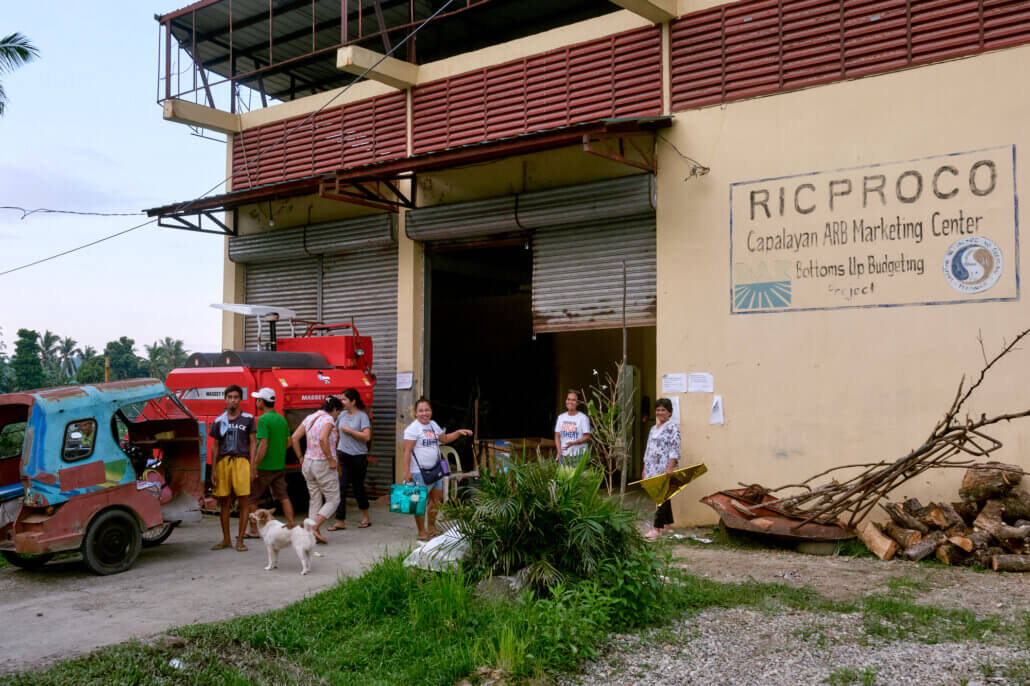
Erna with her fellow co-op members. (Photo by Arianne Gijsenbergh for Action Against Hunger | Surigao City, December 2022)

The project’s livelihood support measures are implemented in cooperation with the local farmer cooperative, where Erna volunteers as finance officer. Her mother was one of the founders.

“My mother’s passion is also my passion: serving our co-farmers. Even though we are poor, we are able to help other people,” says Erna.

Erna at the co-op. (Photo by Arianne Gijsenbergh for Action Against Hunger | Surigao City, December 2022)

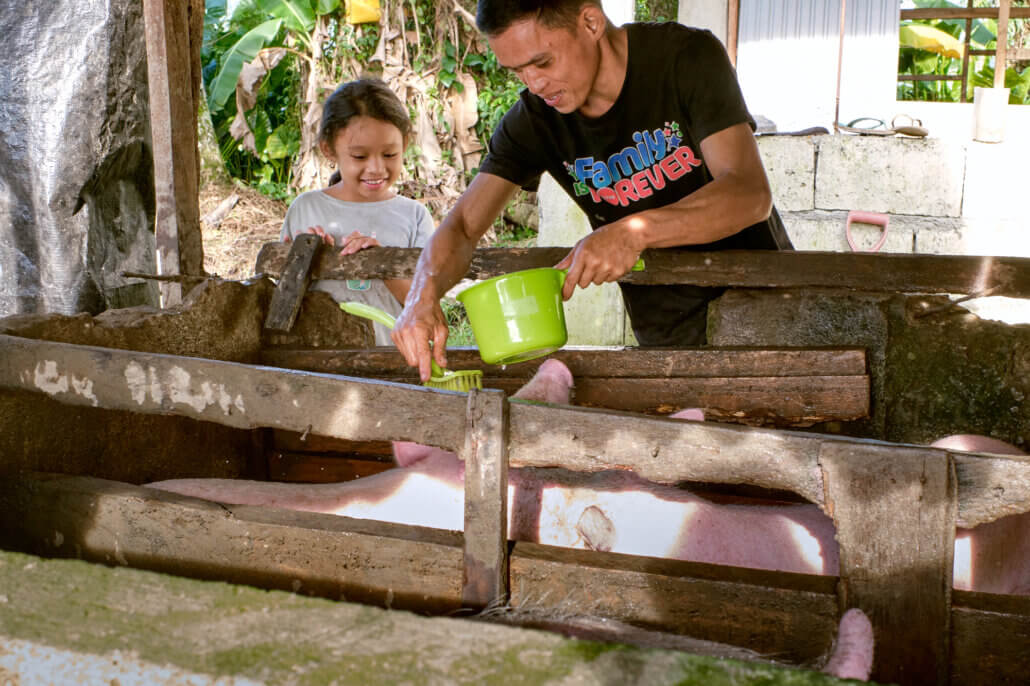
Three months after planting, the rice will be ready for harvest. Erna plans to invest some of their earnings in buying pigs as an additional source of income. The family already owns three pigs which Ruben feeds and washes every morning, while Shekanaiah laughs in delight at the sound of their squeals.

Ruben washing the pigs while Shekainah observes. (Photo by Arianne Gijsenbergh for Action Against Hunger | Surigao City, December 2022)

Erna also wants to open a savings account. “I learned that it is very important to save so that we will not be hungry if a disaster comes. We are very thankful that Action Against Hunger gave us funds to restart our business. Now, we have no debts to repay and can start saving immediately.”

The USAID-funded project supports families like Erna’s to recover from disaster and rebuild fulfilling lives. Erna smiles contentedly, “We are doing well now. Not just well, we are doing good.”

Photo by Arianne Gijsenbergh for Action Against Hunger | Surigao City, December 2022

The livelihood support is part of the ‘Emergency Assistance to Support Local Recovery Capacity of Families and Communities Affected by Typhoon Odette’ project, funded by the United States Agency for International Development’s Bureau for Humanitarian Assistance (USAID-BHA) and jointly implemented by Action Against Hunger, CARE Philippines, and ACCORD Incorporated.


Written by Arianne Gijsenbergh Read more

Supporting livelihoods, caring for families and communities

A family’s livelihood is a means of securing necessities in life. During disasters and humanitarian emergencies, livelihood is one of the most affected areas, thus affecting families. Almost five months after Typhoon Odette, families in Siargao are still trying to bring theirs back.

Before the storm

The community relies on agricultural produce. Leah’s husband, Julito, asks for coconut shells from copra owners to make charcoal since they do not own a farm. He then sells the charcoal and brings 800 to 1,000-peso income a day. Sometimes, they only have 300 pesos when raw materials are scarce.

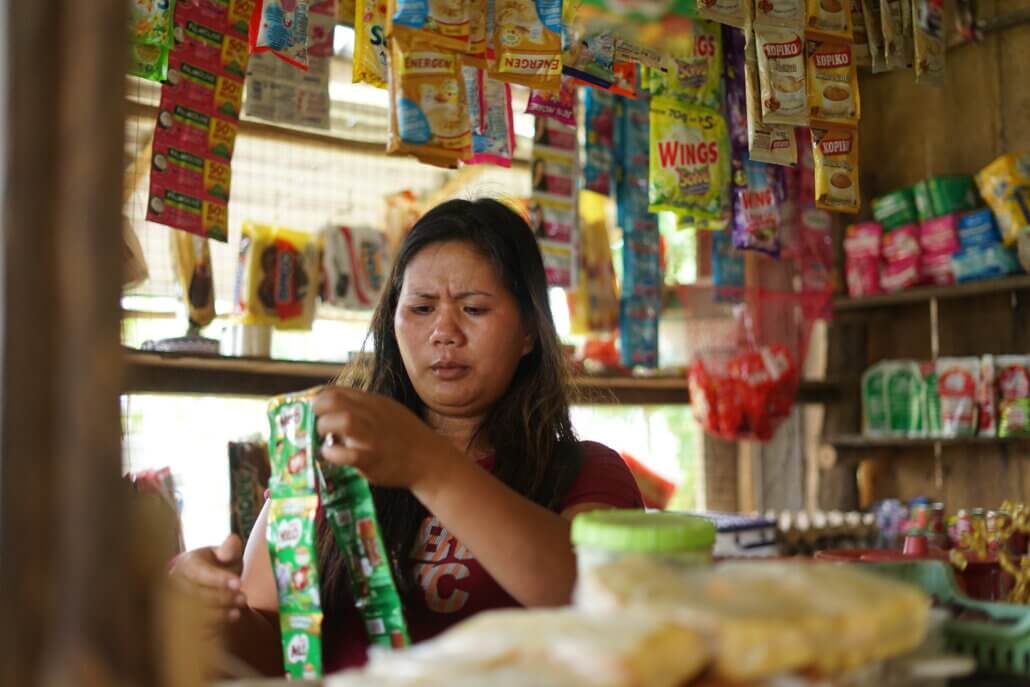
After spending on food and other necessities, Leah would use the spare as capital to buy goods for their small sari-sari store.

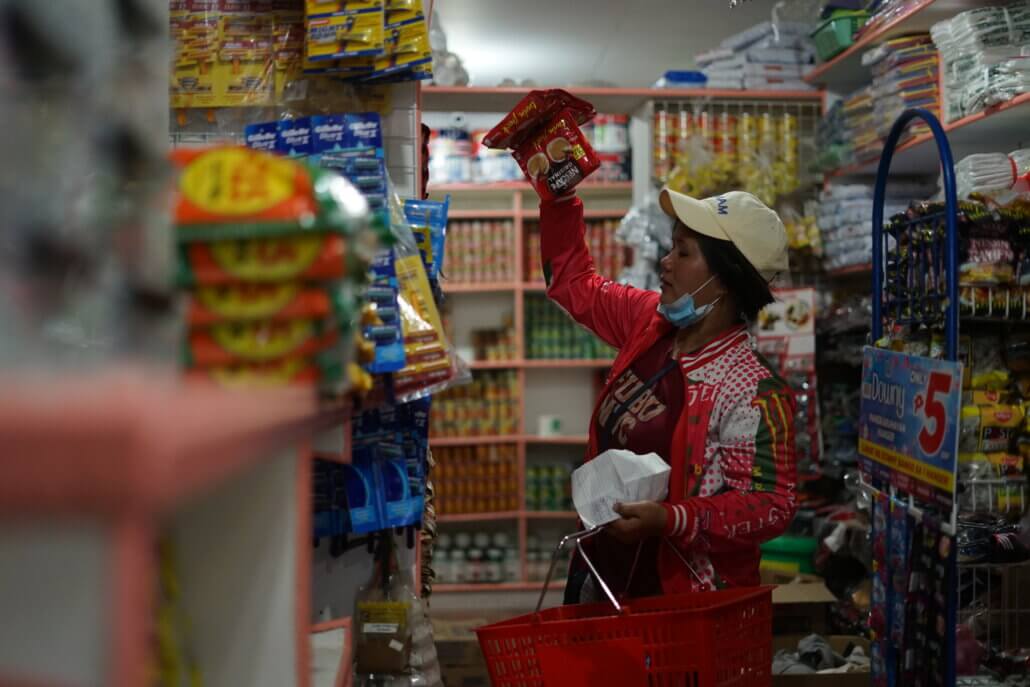
In photo: Leah fills her basket with goods after receiving the cash assistance (Photo by Aliana Gene Sarmiento for Action Against Hunger)

Losing two birds with one disaster

When the area was placed under Typhoon Signal No. 3 last December 14, the family evacuated to a nearby school and left their house and store for hours in fear for their lives.

Leah and her husband came back three days after to find their store toppled and the goods buried in the mud. Leah said her heart sank at the sight of it. She burrowed through the debris to save the undamaged products just so she could still have items to sell.

Her husband however was left jobless after Odette had wiped away hectares of the coconut farms.

“Akong taglig-on ang akong kaugalingon.”

“I try to remain strong,” says Leah Compra-Navales, after their family survived Typhoon Odette. Makabangon-bangon na man ginagmay. “We are coping up, slowly,” she added even though they have lost their livelihood to the typhoon.


Restoring the local economy as a community

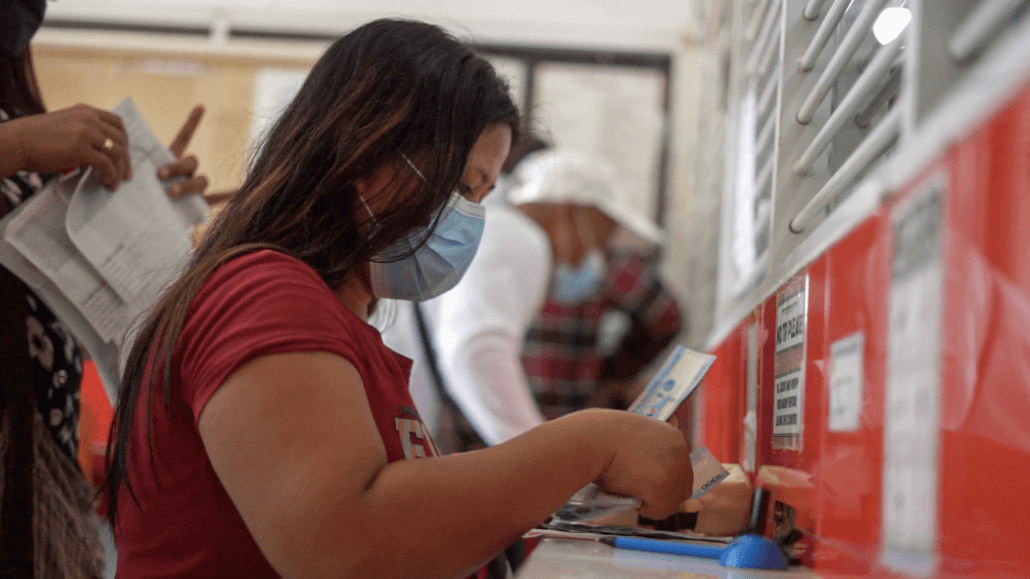
Leah’s family is among the 52 households from Barangay Libertad in the municipality of Sta. Monica that received cash assistance for livelihood restoration. Action Against Hunger’s Typhoon Odette Emergency Response in Caraga gave 10,150 pesos for each affected household in Siargao alone. This is done through the funding of the United States Agency for International Development’s Bureau for Humanitarian Assistance (USAID-BHA) and support from our consortium partners. The assistance under the Emergency Recovery Market System (ERMS) component aims to assist households to re-establish their livelihoods and restore the local economy.
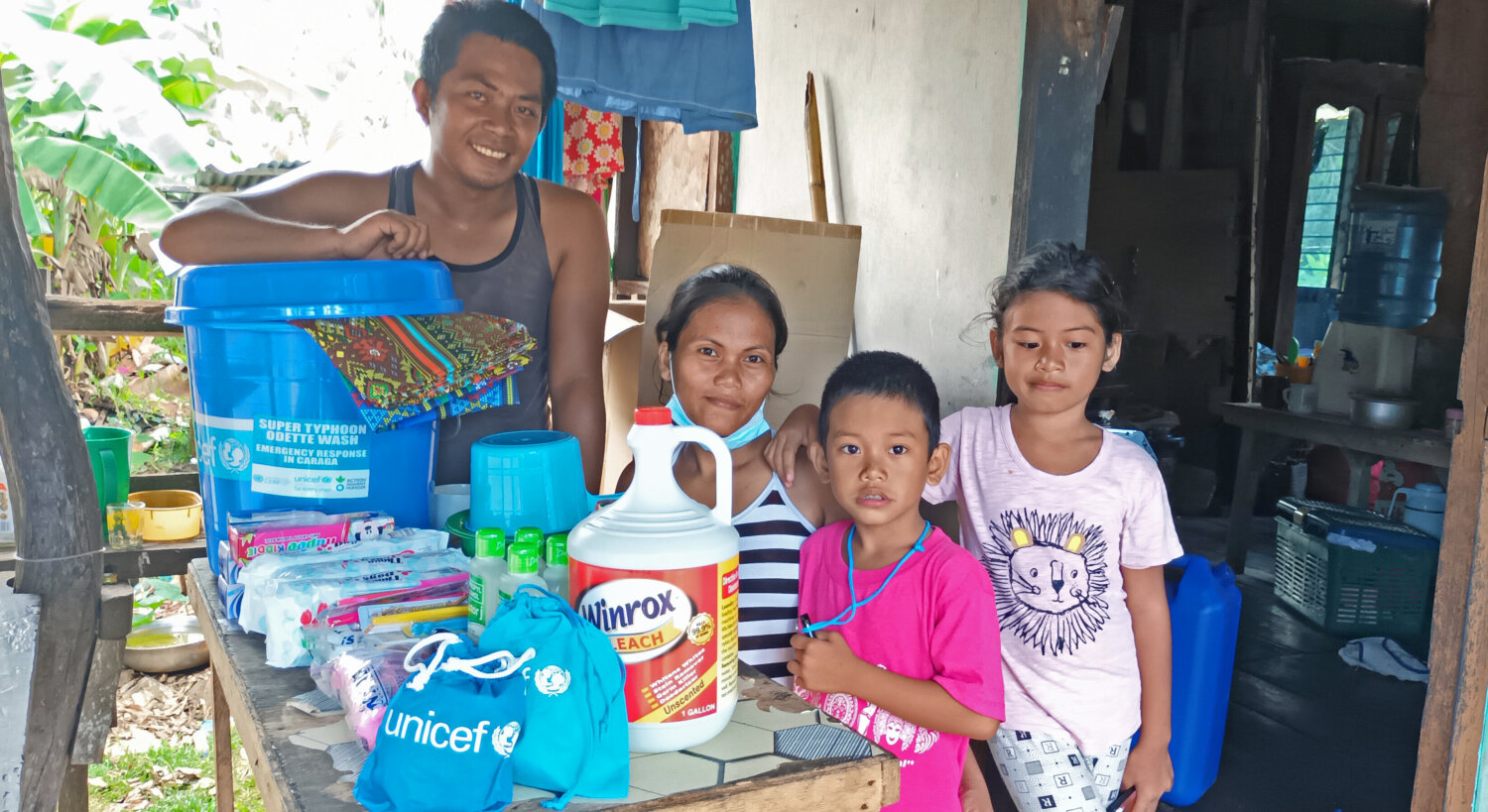
Along with others affected within the community of Libertad, they also received non-food items, hygiene kits, and cash assistance of 5,150 pesos per household for food supplies from Action Against Hunger previous USAID-funded activities.

In photo: Leah receives the cash assistance during the ERMS payout. (Photo by Aliana Gene Sarmiento for Action Against Hunger)

A step closer to livelihood recovery

After receiving ERMS cash assistance, Leah immediately used the money to purchase goods from a local general merchandise store. She filled her baskets with canned goods, sugar, condiments, laundry soap, and more products they could sell. She then filled the display racks in their store with more goods.
In photo: Leah fills her basket with goods after receiving the cash assistance (Photo by Aliana Gene Sarmiento for Action Against Hunger)

Leah said that with the capital they can earn a small steady income every day, and they will not worry about food in the meantime. She is thankful for the opportunity to restart their small business through the help of Action Against Hunger and other organizations.

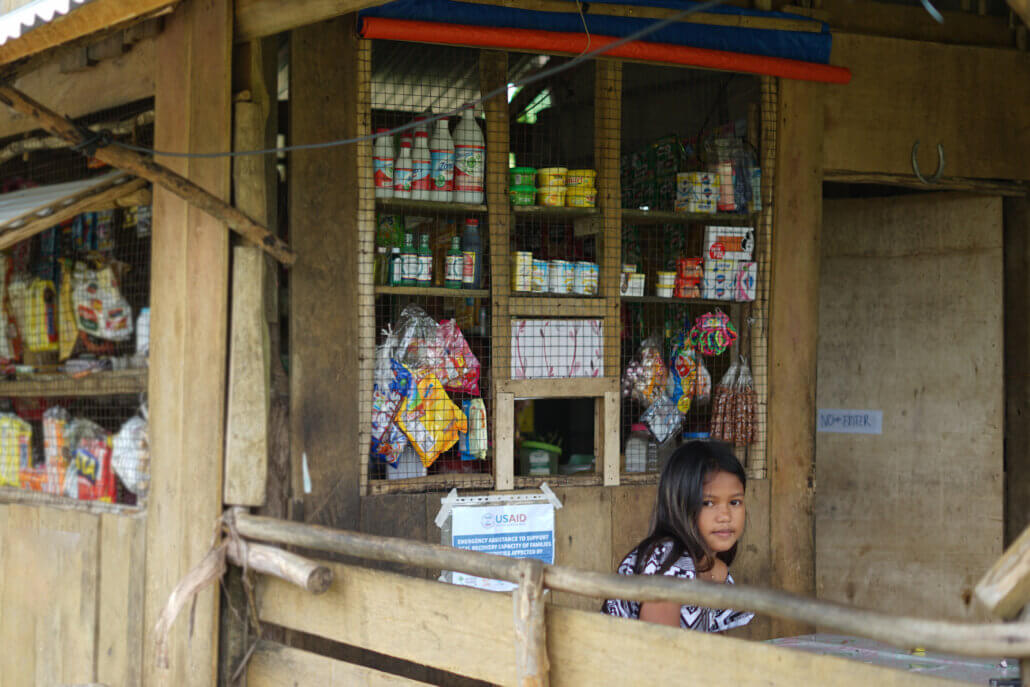
In photo: Leah’s daughter sits in front of their freshly-stocked store. (Photo by Aliana Gene Sarmiento for Action Against Hunger)

The “Emergency Assistance to Support Local Recovery Capacity of Families and Communities Affected by Typhoon Odette in Caraga,” an emergency response project funded by the USAID’s Bureau for Humanitarian Assistance (BHA) which is jointly implemented by Action Against Hunger Philippines, CARE Philippines, ACCORD Incorporated, Agri-Aqua Development Coalition – Mindanao, and Relief International. 


Written by Aliana Gene Sarmiento

Stories from the Field: A Future Doctor

“I want to be a doctor so that I can help people who are victims of disasters,” said 11-year-old Marilou “Monique” Consigna.

Seeing in her own eyes how Typhoon Odette swept her community in Barangay Sta. Paz in San Isidro, Siargao, Monique wants to inspire and influence others so that future generations of children will make a difference.

Monique is 11 years old and currently studying 5th grade in Sta. Paz Elementary School in the Municipality of San Isidro. Her father died last January of 2022 due to sickness, and her mother which is a day care teacher, is now the sole provider for their family. She has six siblings, three of whom have already started their own families.

In the midst of the typhoon, her family evacuated to her sister’s house on the other side of Brgy. Sta Paz. Because of the severe gusts and heavy downpour, they were terrified, appalled and sobbing. For them, it felt like the end of the world at the time. She realized at that point that she was still a child who wants to live life to the fullest. She stills wants to play like any other children and her life should not end there. When they returned home, they were devastated to see that their home had been completely wrecked by the fallen coconut trees and some of parts of their roofing were removed. Despite of what happened, she is still thankful that all their family members were safe and that they were still alive.

She promised to herself that she will work hard in her studies, she particularly enjoys studying English.

Someday, she wants to help her family and community. She wants to be a doctor so that she may aid catastrophe victims. She will use her life to inspire and influence others so that future generations of children will make a difference.

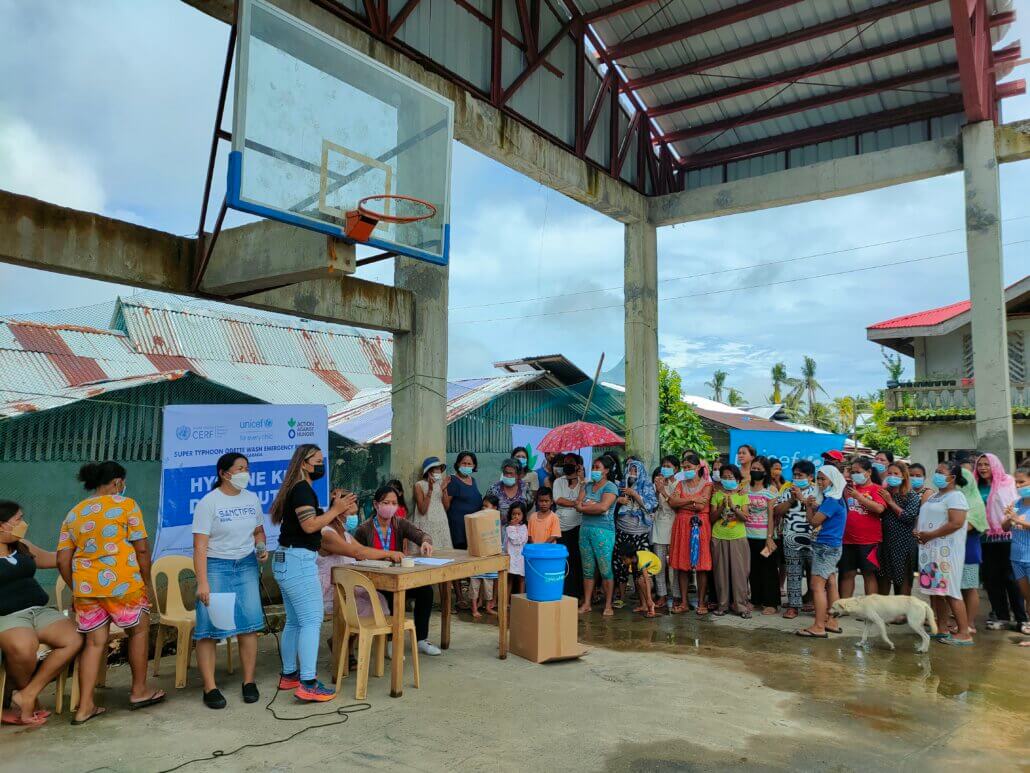
With the support of UNICEF Philippines, Monique’s family was one of the typhoon-affected families who received access to safe water through emergency WASH kits.


Our Super Typhoon Emergency WASH Response in CARAGA is funded by the United Nations Central Emergency Fund (UN CERF), the Republic of Korea, and the Government of Japan through the United Nations Children’s Fund (UNICEF) Philippines. Read more

Staying healthy and safe in times of crisis

“I still remember how hard the wind and rain were that night. The children were crying out of fear.”

These were the words of 34-year-old Geraldine Quire-Quire as she recalls their night at the evacuation center when Typhoon Odette (internationally named Rai) made landfall in Siargao on the 16th of December 2021. As a mother, her family’s safety is her top priority.

Already pregnant with their third child, Geraldine had to take care of their two children and her disabled aunt by herself in the wake of Odette’s rampage. Geraldine’s husband was away in the city working as a watchman at the time.

The intensity of the typhoon was a horrific experience for the children, according to her. To make matters worse, they went home to find that the typhoon had partially damaged their house.

Months later, Geraldine finds some comfort in the life-saving support they received different organizations and government agencies. They are one of the families in Barangay Opong in Taganaan, Surigao del Norte who received water, sanitation, & hygiene materials from UNICEF Philippines through Action Against Hunger’s Super Typhoon Emergency WASH Response in Caraga. According to Geraldine, some of the items will prove to be useful when she gives birth.


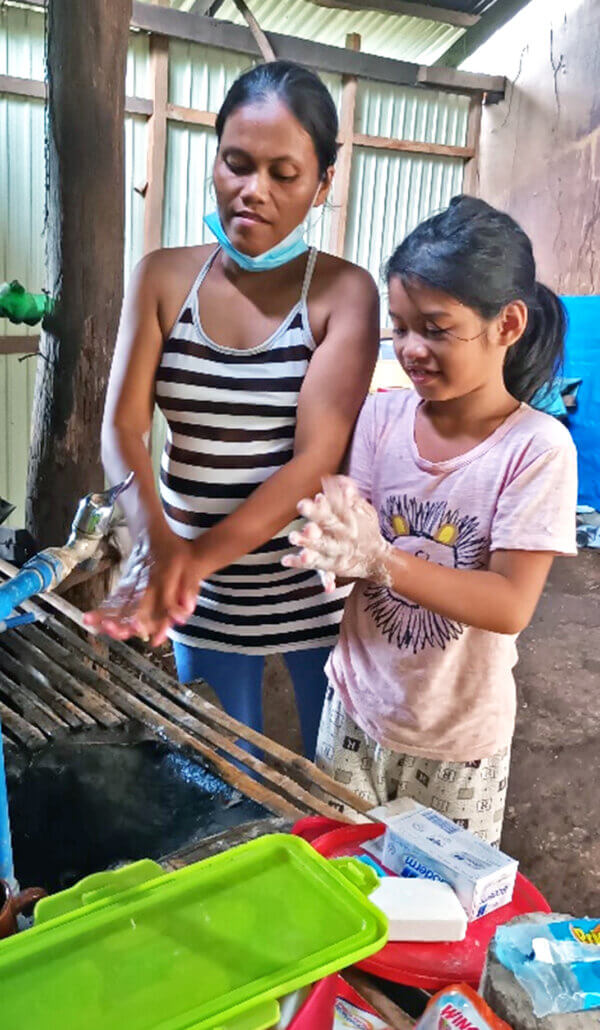
Geraldine also participated in the hygiene promotion sessions of Action Against Hunger. After hearing reminders on COVID safety and how to practice proper hygiene and sanitation, she was eager to teach her children these hygiene habits.

In photo: Geraldine teaches her eldest daughter how to properly wash hands with soap and water based on what she learned from Action Against Hunger’s hygiene promotion sessions. (Photos by Abdul Alim Talusob for Action Against Hunger)

As of July 18, we have reached 81,957 people in Surigao del Norte with life-saving WASH support. Aside from giving access to safe water and sanitation services, our goal is to ensure that families like Geraldine’s adopt and sustain proper hygiene practices.

Our Super Typhoon Odette Emergency WASH Response in CARAGA is funded by the United Nations Central Emergency Fund (UN CERF), the Republic of Korea, and the Government of Japan through the United Nations Children’s Fund (UNICEF) Philippines


Written by Adam Lacson, edited by Joyce Sandajan Read more

Stories from the Field: Jomel Flores

GENERAL LUNA, SIARGAO — Jomel Flores, 31 years old, a member of the LGBT community, and her family were among the hundreds of thousands of Filipinos who were severely impacted by Typhoon Odette’s fury in the islands of Siargao last December 2021. According to her, it was the most horrifying and distressing experience she’s ever had so far in her life.

Rai made its landfall on December 16, 2021 bringing torrential rains, violent winds, floods and storm surges. Jomel and her family took refuge at Anajawan Elementary School in the Municipality of General Luna. They had been warned that the typhoon would be powerful, but when it came, it was significantly more powerful than the locals had anticipated. They were astonished, scared, and afraid when the wind began to blow erratically, pelting them with heavy showers. During that time, children and adults were screaming and crying and all she could do at that second was to pray harder that it will come to pass.

Their experience in the evacuation facility was really difficult, she says. With COVID-19 still a threat, it worried her that there was no social distancing, and they could only use one comfort room.

After spending three days at the evacuation center, they returned home only to find out that their house had been partially destroyed, with some of their roof gone, causing their personal belongings to become damp and damaged. This rendered Jomel speechless and all she could think at that moment was to cry. Despite the fact that it was the saddest and most agonizing event she had ever had, she was still thankful that all of her family members were safe and alive. “That was the most important thing, material stuffs may be replaced, but life will never be replaced,” she says.

It’s been months since Typhoon Odette, but Jomel still sheds tears every time she remember the horrific experience they went through. Despite being one of the most frightening experiences they’ve had, Jomel is thankful that all of their family members are alive and safe. “That’s the most important thing. Material stuff come and go, but one’s life can never be replaced,” she says

Her hope for the future is to become financially stable and to open a large ihaw-ihaw (barbecue) store to support her family. She also wants to make a modest contribution to her community by offering inexpensive healthy meals. She aspires to be the change she wishes to see in the world.

The Flores family is among the thousands of affected families in Surigao del Norte who were given life-saving water, sanitation, & hygiene support immediately after Typhoon Odette made landfall on December 16.


The Super Typhoon WASH Emergency Response in CARAGA is implemented by Action Against Hunger with funding from the United Nations Central Emergency Response Fund (UN CERF) and United Nations Children’s Fund (UNICEF). Read more

STORIES FROM THE FIELD: Breaking bias in times of emergencies

Alam ko kasi yung hirap sa tubig dito sa amin. Lalo na ngayong bumagyo, hindi kami siguradong malinis yung tubig mula sa balon…Ginagawa ko ito ‘di lang para sa pamilya ko, kundi para sa buong baryo namin dahil alam ko yung hirap namin sa tubig rito.”

I know how difficult the water situation is in our area. Especially after the typhoon, we’re not sure if the water from the deep well is clean. I [volunteer] not only for my family but also for our whole village because I know how hard it is for us to get water here.)
Daisy A. Jumandos, Monitoring Volunteer, 39 years old and resident of Barangay Magsaysay, General Luna, (Siargao Islands, Surigao del Norte)

Daisy Jumandos and her family were one of the residents of Barangay Magsaysay, General Luna in the islands of Siargao caught in the eye of Super Typhoon Odette when it made landfall on December 16, 2021.

In photo: Daisy Jumandos | Photo by Adam Daniel Lacson for Action Against Hunger (2022 March 03, Surigao del Norte, Philippines)

According to 39-year-old, their family received news of an incoming storm, but were clueless of its strength and magnitude. Daisy shared the horror that she, her husband, and their three children had endured after being trapped in their home when Odette was at its strongest. “Hindi na kami nakapaghanda o nakatakbo. Biglaang dumilim yung buong paligid na hindi na namin makita kahit ang mga kapitbahay. Napakalakas ng hangin kaya di na rin kami nakalabas ng bahay. Nagsiliparan ang bubong namin.’ (We could no longer prepare for it nor evacuate. It suddenly became dark outside, so much so that we couldn’t even see the neighbors. The wind was so strong that we could not get out of the house. Our roof flew off.)”

According to her, they thought that they weren’t going to make it out alive. “Sabi ng panganay ko, ‘Ma! Kalian kalian ba ito titigil? Nag-iiyakan na kami at akala namin ay heto na ang katapusan namin. (My eldest [child] said, ‘mom, when will this stop? We were crying and we thought it was the end of us.),” Daisy added.

After Odette, the situation of the Jumandos family, like many others affected, was bleak. “We endured [our situation] for a while,” she explained. Their family already did not have a regular source of income since the pandemic. So, when they needed to prioritize saving up for house repairs—distilled water or octane for cooking became necessities that they could no longer afford.

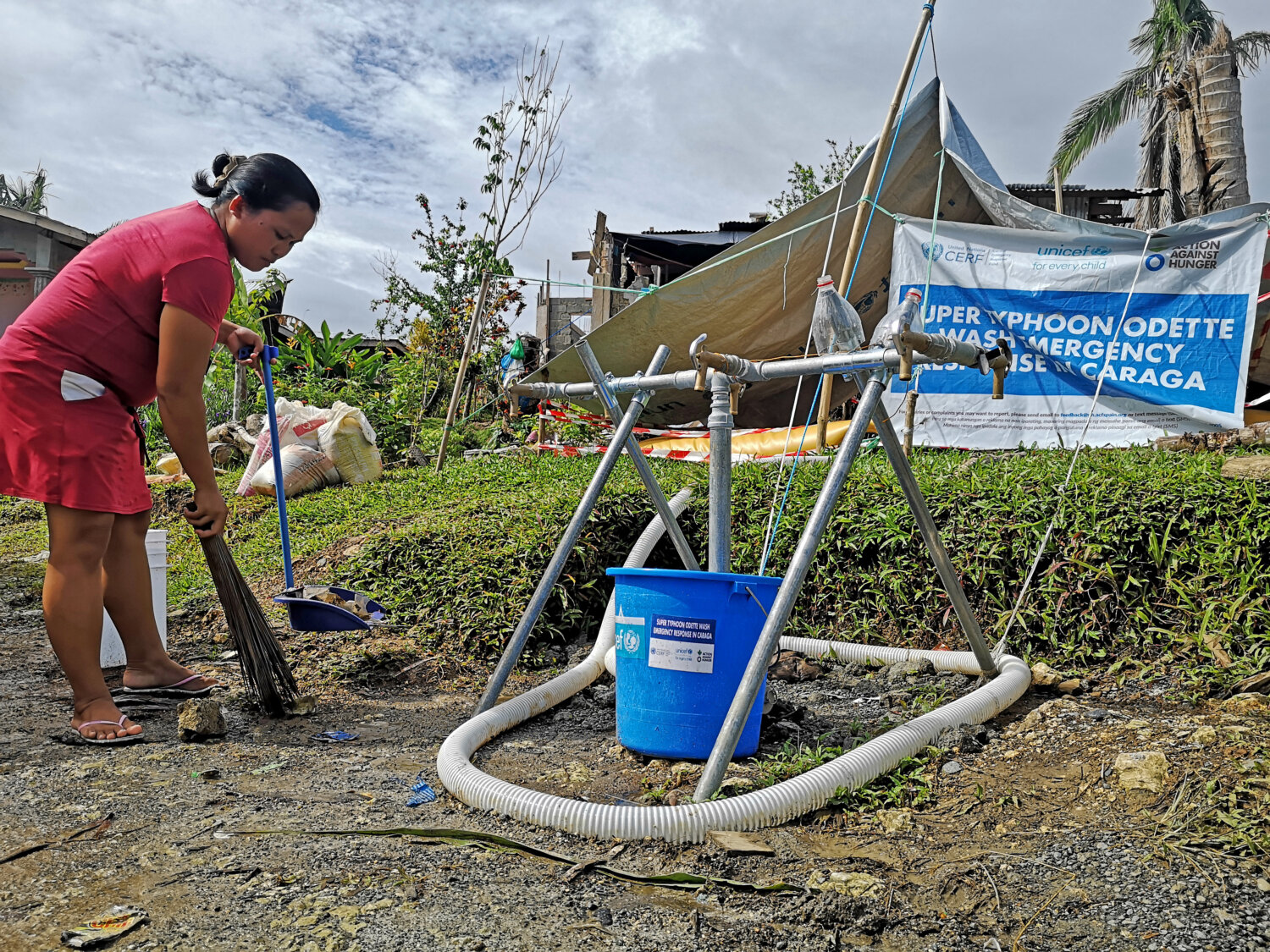
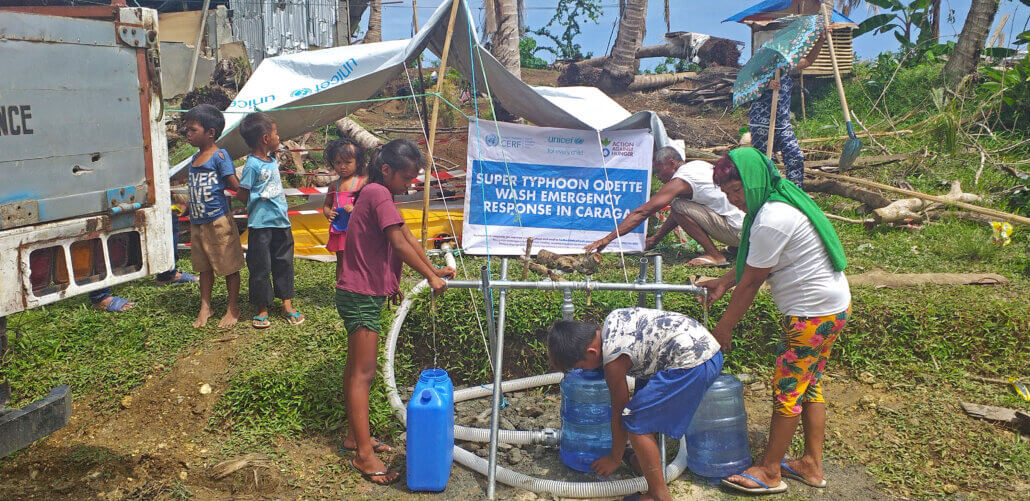
By February 2022, Action Against Hunger installed water bladders in the affected communities of the Caraga region which have limited access to potable water. This was part of the Super Typhoon Odette WASH Emergency Response supported by the United Nations Children’s Fund (UNICEF) and United Nations Central Emergency Fund (UN CERF).

“I know how difficult the water situation is in our area. Especially after the typhoon, we are not sure if the water from the deep well is clean… It is important for me to have clean water here in the community, that is what drives me to handle the water situation here. I am proud that I was chosen as a volunteer because I want to do something for our community,”

As one of the parent-leaders in their barangay, Daisy volunteered to help monitor the water bladders. “Alam ko kasi yung hirap sa tubig dito sa amin. Lalo na ngayong bumagyo, hindi kami siguradong malinis yung tubig mula sa balon… (I know how difficult the water situation is in our area. Especially after the typhoon, we are not sure if the water from the deep well is clean,)” were Daisy’s sentiments.

Photo by Arjay Gaylon for Action Against Hunger

She further shared about her motivation and how she takes pride in her volunteer work, saying “importante kasi sa akin na may malinis na tubig kami rito sa baryo, iyon nagtutulak sa akin na alagaan yung tubigan rito. Proud rin ako na napili ako bilang volunteer dahil gusto kong may nagagawa ako para sa community namin. (It is important for me to have clean water here in the community, that is what drives me to handle the water situation here. I am proud that I was chosen as a volunteer because I want to do something for our community.)”

“My family offers support in other tasks. For example, if I have chores at home, the children will help manage [the water bladders],”

Daisy also breaks the bias on gender roles as she takes on and delegates different tasks both inside and outside their home. She shared that after Typhoon Odette, she has been hands-on in repairing their house. She mixes cement and helps in carrying the materials needed for their repairs. When asked if she finds it challenging, she said that, “kaagapay ko ang pamilya ko sa mga gawain. Halimbawa, kung mag ginagawa ako sa bahay, tumutulong mga anak ko sa pag-asikaso sa tubigan. Hindi naman it istorbo dahil alam kong para sa aming lahat ito eh. (My family offers support in other tasks. For example, if I have chores at home, the children will help manage [the water bladders].”

For Daisy, gender equality in the household can be achieved when men, women, boys, and girls can truly communicate and understand each other. In any aspect of decision-making in their lives, Daisy shares that it is important to discuss and share opinions openly, as well as have equal voices when it comes to making plans. It is a sign of mutual respect.

In photo: Daisy Jumandos | Photo by Adam Daniel Lacson for Action Against Hunger (2022 March 03, Surigao del Norte, Philippines)

Not only motivated by her family, Daisy also shares she gets inspiration from her neighbors. “Ginagawa ko ito ‘di lang para sa pamilya ko, kundi para sa buong baryo namin dahil alam ko yung hirap namin sa tubig rito. (I [volunteer] not only for my family but also for our whole village because I know how hard it is for us to get water here),” she added.

Around 650 people in Barangay Magsaysay are now able to access potable water for free through the newly installed water bladders.

The Super Typhoon WASH Emergency Response in CARAGA is implemented by Action Against Hunger with funding from the United Nations Central Emergency Response Fund (UN CERF) and United Nations Children’s Fund (UNICEF).


Written by Queen Harley Musico, Abdul-Alim Talusob, Adam Daniel Lacson | Edited by Joyce Anne Sandajan
Read more