Lighting the way for health: A midwife’s journey to bring safer health services to mothers and children in Mapayag
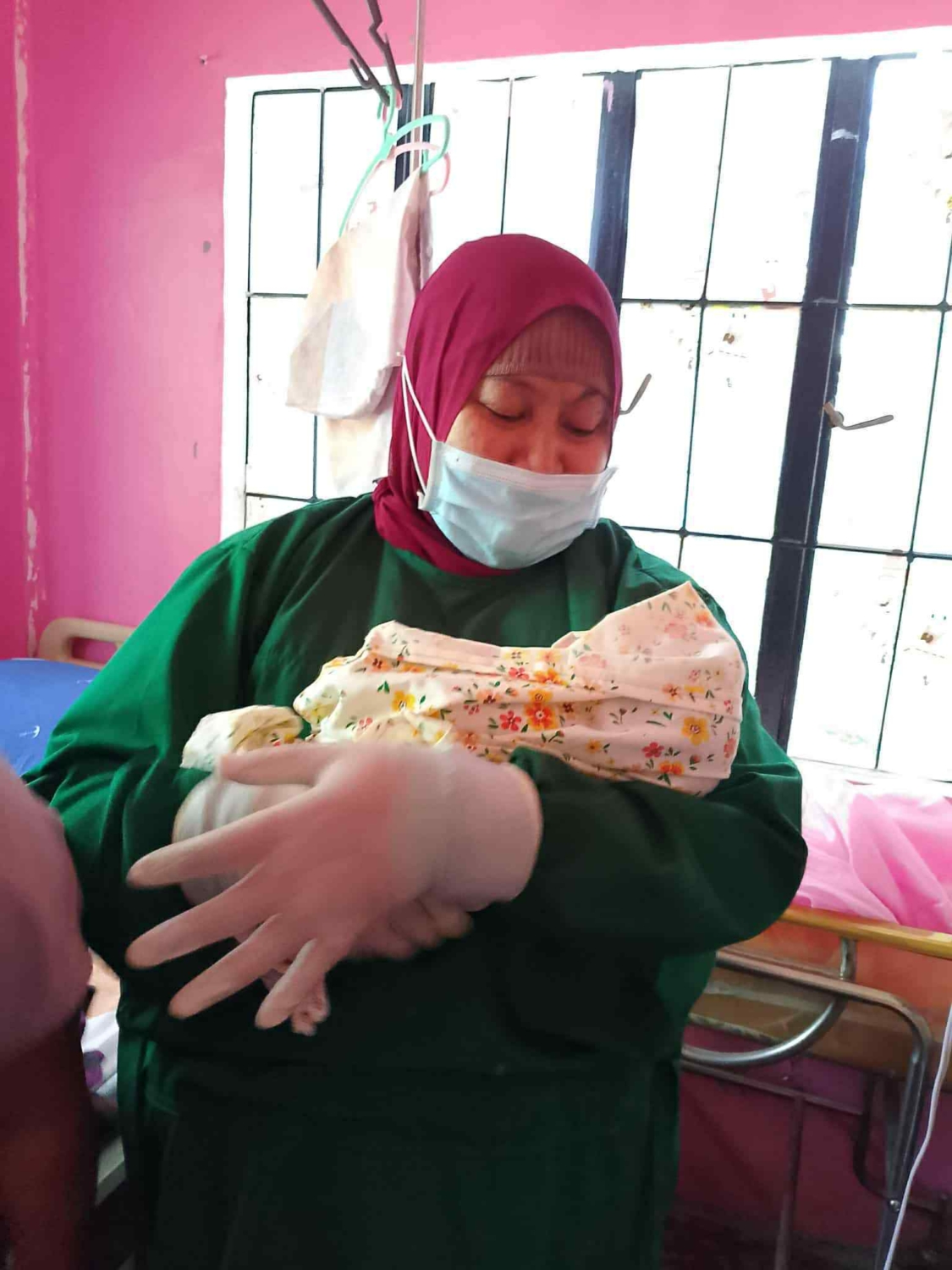
DATU ANGGAL MIDTIMBANG, MAGUINDANAO DEL SUR — In Barangay Mapayag, where resources have long been scarce, midwife Zei has become a constant presence, ensuring mothers and children receive the care they need.
For more than a decade, Zei, 53, has walked the extra mile—literally and figuratively—for her community. A midwife at the health station in Barangay Mapayag, Zei travels two hours every day from her home in Sultan Kudarat just to open the small facility that caters to more than 3,700 residents.
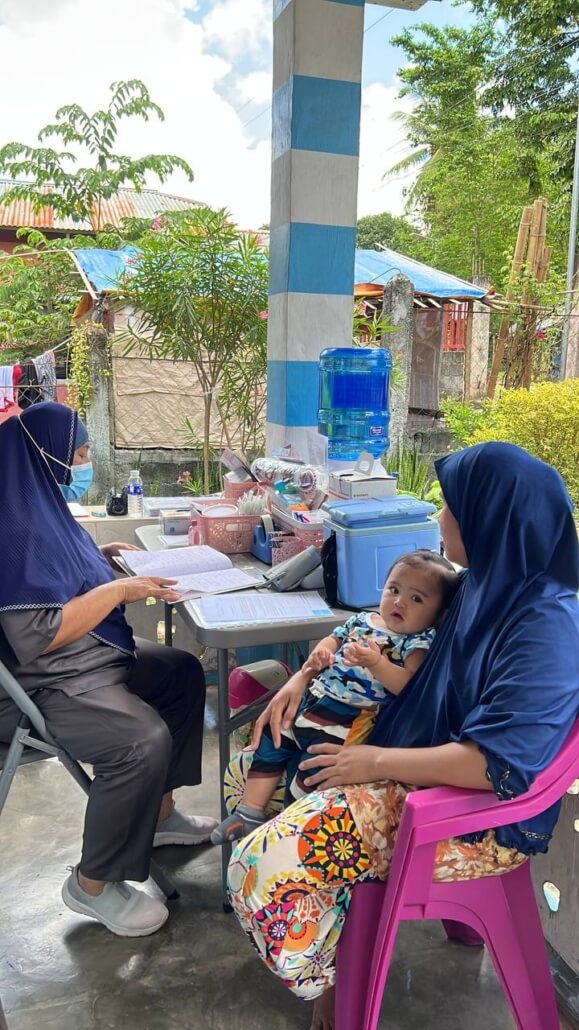
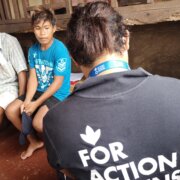
In photo: Before assessing a child’s nutritional status, the Zei carefully gathers essential details such as medical history, appetite, and overall health condition.
Photo by Moner Dipatuan for Action Against Hunger
Her commitment to her work never wavered, yet the conditions she faced each day were far from ideal. For years, the barangay health station in Mapayag struggled without a reliable water supply. Maintaining basic sanitation and hygiene, which is a necessity in any health facility, became a constant uphill battle.
“I buy two big buckets from a water truck every week for fifty pesos. Sometimes, when it rains, we collect water just so we have something for cleaning.” – Zei, Midwife
Zei bore much of the cost herself, spending around fifty pesos a week from her modest salary to buy water from a truck, just to keep the health station clean. She claims, “mula pa noong 2013, wala pong sariling tubig ang BHS. Ang ginagawa ko, bumibili ako ng tubig mula sa water truck—dalawang malaking balde, bale fifty pesos iyon bawat linggo. Minsan kapag umuulan, nag-iipon din po kami para may magamit panglinis” (Since 2013, the BHS hasn’t had its own water supply. I buy two big buckets from a water truck every week for fifty pesos. Sometimes, when it rains, we collect water just so we have something for cleaning.)
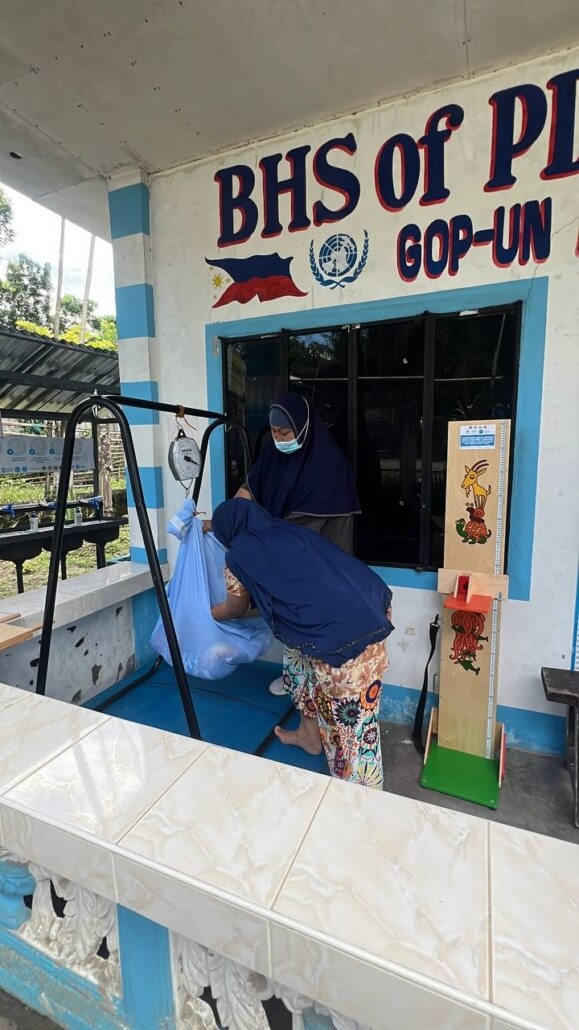
n photo: A child’s weight, height, and MUAC are measured to
monitor nutritional status and check for signs of malnutrition.
Photo by Moner Dipatuan for Action Against Hunger
The strain was not hers alone to carry. Families who came to the health station also shared the burden, especially expectant mothers. Zei shares that “kapag may naganganak, pinapadala ko ang husband or kamag-anak nung manganganak ng dalawa hanggang tatlong timba ng tubig para may malinis na magamit” (Whenever someone is about to give birth, I would ask the husband or relatives to bring two to three buckets of water so we would have clean water to use.)
“Before, I had to close the BHS as early as 3PM. I worried about the lack of light, the lack of water, and my safety if I stayed longer. So when emergencies happened at night, people went straight to the hospital because the BHS was closed.”
By 2017, another challenge made the situation even more difficult: the health station lost electricity. Without power, the facility was plunged into darkness by late afternoon, forcing Zei to close as early as 3 PM.
The lack of lighting not only limited services but also raised safety concerns. Emergencies that occurred at night went unanswered, leaving families with no option but to travel far to the nearest hospital.
“Dati maaga pa lang, mga 3PM, nagko-close na po ako ng BHS. Concern ko talaga yung walang ilaw, walang tubig, iniisip ko rin ang safety ko if mag-stay dito. Kaya pag gabi na may emergencies, diretso na ang mga tao sa hospital kasi sarado ang BHS” (Before, I had to close the BHS as early as 3PM. I worried about the lack of light, the lack of water, and my safety if I stayed longer. So when emergencies happened at night, people went straight to the hospital because the BHS was closed,) she added.
Despite these hardships, Zei pressed on—often improvising with outdated or makeshift equipment, and carrying the weight of her community’s needs almost entirely on her own.
In 2025, UNICEF, together with Action Against Hunger, began formally working with the Ministry of Health in the Bangsamoro Autonomous Region in Muslim Mindanao (BARMM) through the project “Strengthening Health and Nutrition Service Delivery Capacities in Early Learning, Alternative Learning, and Community Health,” supported by funding from the Korea International Cooperation Agency (KOICA).
The project seeks to enhance the capacity of Early Childhood Care and Development facilities to deliver essential health, nutrition, and water, sanitation & hygiene services. Through this initiative, the BHS in Mapayag started experiencing long-awaited improvements in its facilities and services.
“This project by Action Against Hunger and UNICEF has been such a huge help. First of all, we now have water both inside and outside the BHS. I no longer need to buy or fetch it myself.”
In Mapayag, one of the first major changes was access to water. A rainwater catchment system was installed and connected through piped water to the health station. Handwashing stations were also built—both inside and outside the facility—for the use of staff and patients alike. For the first time in more than a decade, Zei no longer had to buy or fetch water herself.
Families also felt the difference, as they no longer needed to bring buckets during childbirth. “Sa tulong po na ito, I hope na mas marami pa ang mga taong maserbisyuhan, makita nila ang kahalagahan ng kalusugan, lalo na sa mga bata” (Because of this support, I truly hope that more people will be served and that they will come to recognize the importance of health, especially for their children,) said Zei.
Another long-awaited change came with the installation of solar power.
The provision of a solar panel system, complete with battery and inverter, meant that the health station could finally function even after dark.
For Zei, this was a turning point—allowing her to stay at the BHS 24 hours a day from Monday to Friday. Emergencies at night could now be attended to within the community, rather than requiring long trips to distant hospitals.
She shares, “ngayon, kahit may manganak ng gabi o madaling araw, andito ako. Open po ang BHS” (Now, even if someone gives birth late at night or early in the morning, I’m here. The BHS is open.)
“Now, even if someone gives birth late at night or early in the morning, I’m here. The BHS is open [..] Since we were trained under PIMAM, I now know the proper way to check children. Even the barangay health workers and nutrition scholars are more confident now and I have more support.”
The project also addressed small but crucial details that affected daily health practices. Soap and cleaning materials were provided to help maintain hygiene standards. Drainage issues behind the facility, once a source of stagnant water and potential disease, were resolved through a proper soak pit system.
Patients visiting the BHS could now wash their hands easily, helping promote better hygiene behaviors such as frequent handwashing and safe waste disposal.
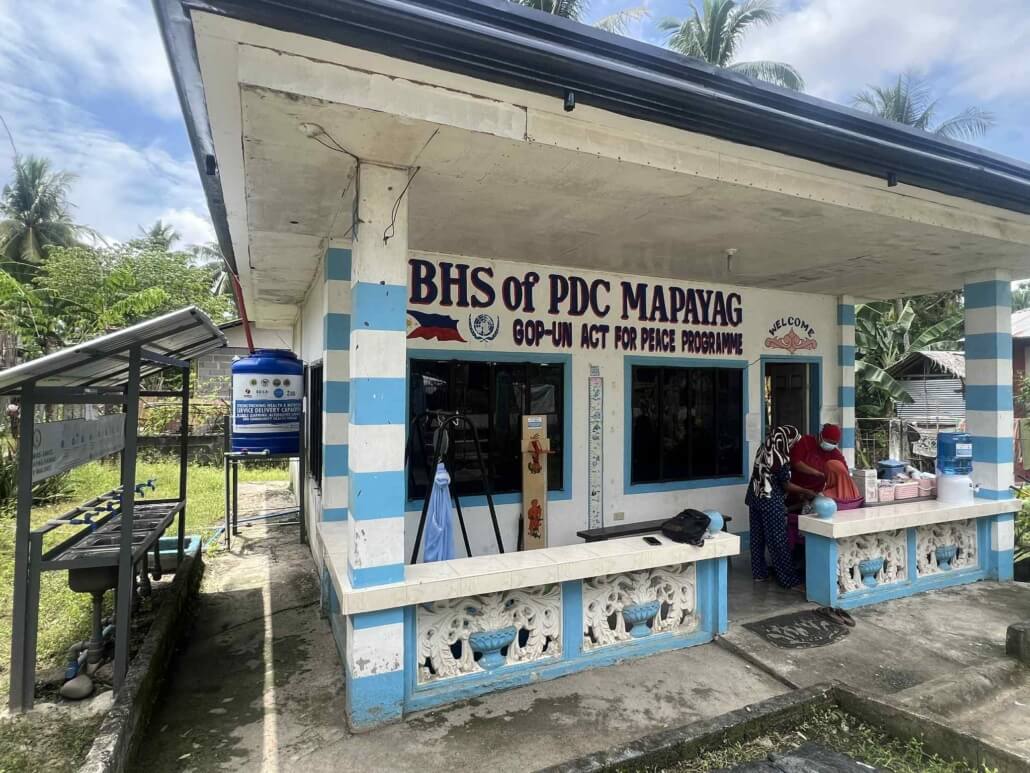
In photo: The rain water catchment system in the barangay health station of Mapayag. Hygiene advocacy materials were also placed near the handwashing station. Photo by Moner Dipatuan for Action Against Hunger
Equally important were the tools that made Zei and her colleagues’ work more accurate and effective.
For years, they had been using improvised equipment—bathroom scales meant for adults to weigh children, and torn paper charts taped to the wall as makeshift height boards. With new anthropometric tools such as height boards, weighing scales, and MUAC tapes, health workers could now properly monitor children’s growth and detect malnutrition early.
Training and capacity building completed the transformation. Barangay health workers (BHWs) and barangay nutrition scholars (BNS) received guidance that gave them more confidence in assisting Zei.
“Since we were trained under PIMAM, alam ko na po ang proper way ng pag-check sa bata. Kahit ang mga BHW at BNS ngayon, confident na sila. Hindi na ako lahat ang gumagawa gaya ng dati” (Since we were trained under PIMAM, I now know the proper way to check children. Even the barangay health workers and nutrition scholars are more confident now and I have more support,) Zei added.
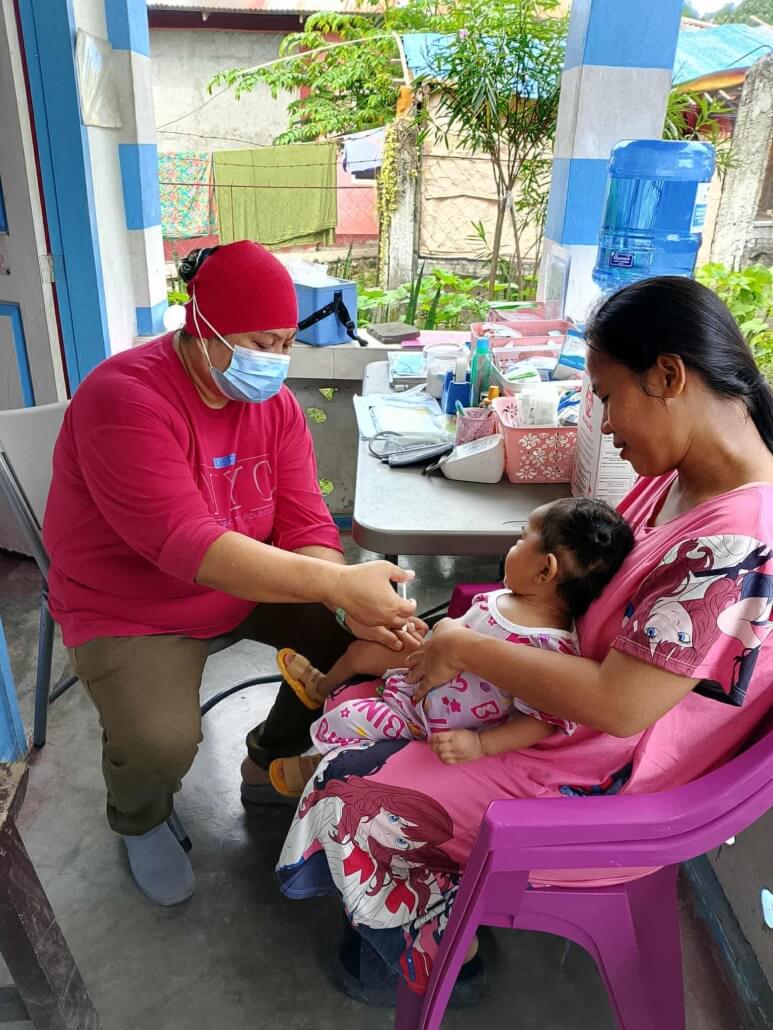
In photo: Zei administers routine immunizations, conducted every Wednesday at the BHS. Photo by Moner Dipatuan for Action Against Hunger
The results are clear in the numbers: immunization rates in Mapayag rose from 39 in July to 76 percent by August 2025, while the number of consultations nearly doubled within the same period. Mothers who previously resisted bringing their children now come voluntarily.
Zei explains, “ngayon din po, ‘yong mga nanay ng mga batang mahirap papuntahin dito sa BHS at magpa immunize ng anak nila, ay pumupunta na po dito sa BHS at hindi na kailangan pilitin at balik-balikan. Siguro dahil narinig nila yung tulong na ginawa ng Action Against hunger at UNICEF, pati ang pagbabago dito sa BHS ay na-engganyo na silang pumunta dito na di na kailangan pilitin katulad dati” (These days, even mothers from farther side of the barangay, those we usually struggle to convince, are now coming to the barangay health station to have their children immunized. We no longer need to convince them or follow up repeatedly. I think it’s because they’ve heard about the support provided by Action Against Hunger and UNICEF, and they’ve seen the improvements made to the BHS. The changes have encouraged them to come voluntarily—unlike before, when it was a struggle to get them here.)
Her colleagues in other barangays have also taken notice. “Madalas sinasabi nila, blessed daw ako at ang BHS namin kasi kami ang napiling tulungan. Sana matulungan din ang ibang BHS na nangangailangan ng parehong support” (Other midwives often say how blessed I am, that our BHS was chosen to receive support. I hope other health stations in need will also be helped in the same way,) said Zei.
“We no longer need to convince them or follow up repeatedly. I think it’s because they’ve heard about the support provided by Action Against Hunger and UNICEF, and they’ve seen the improvements made to the BHS. The changes have encouraged them to come voluntarily—unlike before, when it was a struggle to get them here.”
For Zei, the transformation of the health station in Mapayag is more than just about infrastructure—it is about dignity, safety, and hope.
Families who once had to endure long travel for care now find reliable support close to home. And for the midwife who has walked this journey for over a decade, the changes have strengthened her resolve to keep serving.
*PIMAM – Philippine Integrated Management of Acute Malnutrition
The “Strengthening Health and Nutrition Service Delivery Capacities in Early Learning, Alternative Learning, and Community Health” project is implemented by Action Against Hunger together with UNICEF, thanks to the funding support of the Korean government through the Korea International Cooperation Agency (KOICA).
Written by Joyce Sandajan
Contirbutors: Debbie Alaban
Interview and photos by: Debbie Alaban and Moner Dipatuan